WhatsApp Username & BSUID: What Indonesian Business Owners Need to Know Right Now
WhatsApp Username & BSUID: What Indonesian Business Owners Need to Know Right Now
You run a clothing store in Jakarta. Instagram is picking up, TikTok is driving traffic, and WhatsApp is where deals actually close.
Then this happens: a customer watches your TikTok video and wants to chat. But she doesn't have your number, and your bio doesn't have a WhatsApp link. She can't find you. The sale disappears.
This isn't rare. Indonesian SMEs lose orders every day because customers can't find the entry point.
WhatsApp is building a fix. Coming soon: users will be able to search @yourbrand directly inside WhatsApp and start a conversation — no phone number needed.
But for business owners, the username is just the surface layer. What's worth understanding right now is something called BSUID — because it determines whether your system can recognize "we've talked to this person before."
What Is a WhatsApp Username?
It's a public brand handle — like @tokobaju — that lets customers find and message you directly from WhatsApp search, without knowing your phone number.
Instagram and TikTok have worked this way for years. WhatsApp is the last major messaging app to adopt it — and given how central WhatsApp is to commerce in Indonesia, this update has real implications for how customers find you.
A few things to be clear on:
- A username is not a new account type — your existing WhatsApp Business number stays exactly as it is
- It adds a layer on top of your phone number, it doesn't replace it
- Phone numbers remain the foundation for registration, OTP, and account security — that doesn't change
Will Usernames Replace Phone Numbers?
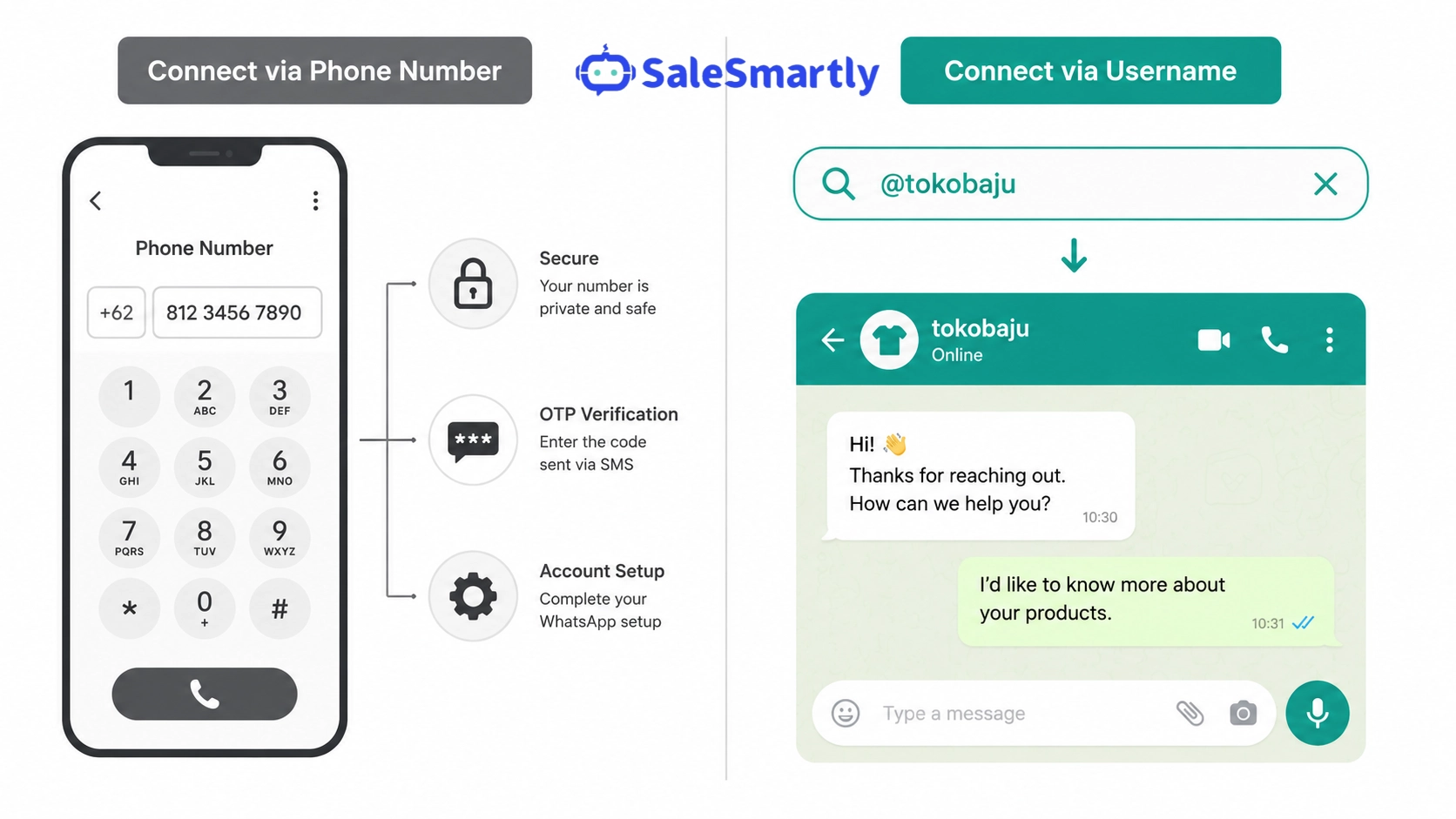
No. The first question most business owners ask. The answer is straightforward: phone numbers are still the backbone of every WhatsApp account — registration, verification, security. That's not changing.
Here's a useful way to think about it: your phone number is your business license. Your username is the sign above your door.
| Function | Phone Number | Username |
|---|---|---|
| Account registration | ✅ Required | ❌ |
| OTP verification | ✅ Required | ❌ |
| Customer search & discovery | Share manually | ✅ Searchable |
| Consistent branding across platforms | ❌ | ✅ |
What Actually Changes for Your Business?
From a customer's perspective, a username is just a more convenient way to reach you.
From your operations team's perspective, something more fundamental shifts: the logic of how customers get identified.
Right now, your CS team uses phone numbers to recognize people. A customer sends a message, the system pulls up their number, and the CRM shows their purchase history, past conversations, complaints — everything hangs off that number.
Soon, a customer might contact you via username and never share their phone number at all. If your system only understands phone numbers, that customer shows up as a complete stranger — even if they ordered from you last week.
What changes:
| Area | Impact |
|---|---|
| Customer entry point | Username becomes a new acquisition channel |
| Customer identification | Can't rely on phone number alone |
| CRM logic | Must handle multiple identity types simultaneously |
| CS handoff | Agents need username, BSUID, and phone number linked to one profile |
What stays the same:
| Area | Status |
|---|---|
| WhatsApp account infrastructure | Still phone-number based |
| Messaging capabilities | Unchanged |
| OTP and verification flows | Still phone number |
How Should You Plan Your Username?
WhatsApp hasn't published final rules, but the test version and Meta's broader ecosystem make the direction clear.
What makes a username work:
- Matches your brand name exactly
- Short, memorable, easy to type on mobile
- Consistent with your Instagram and TikTok handles
✅ @tokobaju — clean, searchable, on-brand
❌ @official_tokobaju_indonesia_2026 — nobody will remember this or search for it
For Indonesian SMEs already active on Instagram and TikTok, the priority is cross-platform consistency. If three platforms have three different names, customers searching for you will hit a wall. That friction costs trust.
Brand name squatting is a real risk. Once usernames open up, popular brand names will get claimed fast — exactly like what happened with Instagram handles in the early days. Verified WhatsApp Business accounts are expected to get priority access for brand name protection.
If you haven't completed WhatsApp Business verification yet, now is the right time to move on that.
What Is BSUID — and Why Does It Matter More Than the Username?
BSUID stands for Business-Scoped User ID.
Don't worry about the full name. Here's what matters: **it's a unique ID that WhatsApp automatically generates for each customer–business relationship.**
When a customer contacts your business, WhatsApp creates a BSUID for that connection and passes it to your system via API or Webhook. That ID is then used to identify the customer in all future interactions.
Key characteristics:
- Isolated per business. The same customer contacts you and gets BSUID_A. They contact a competitor and get BSUID_B. The two are completely unrelated — no cross-business tracking.
- Contains no phone number. You can't reverse-engineer a BSUID to find out who it belongs to.
- System-level only. Customers never see it. It lives between WhatsApp's backend and your system.
Why this is the bigger operational shift:
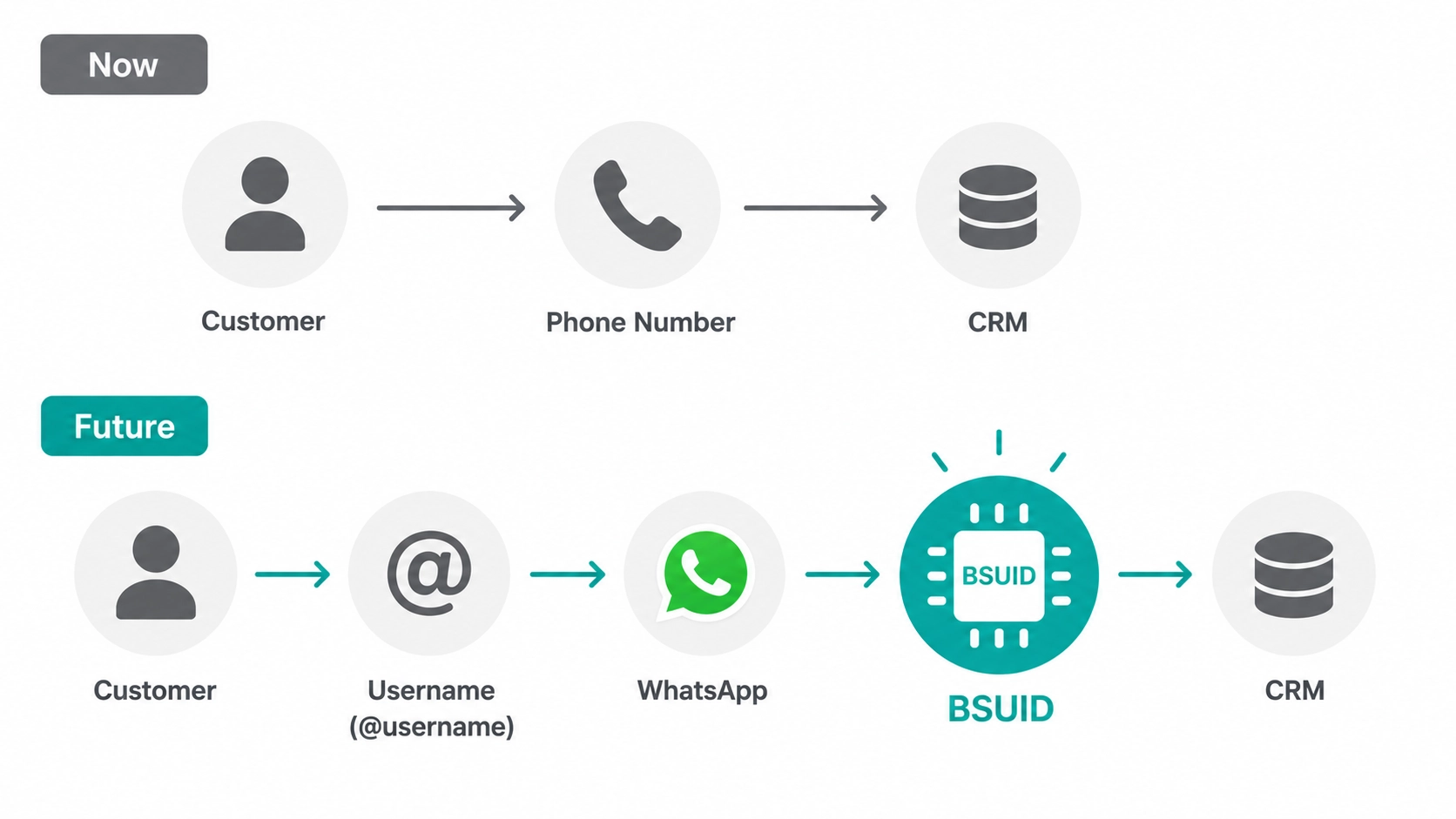
Today's identity chain: Customer → Phone number → Your CRM
Tomorrow's identity chain: Customer → Username → WhatsApp → BSUID → Your CRM
If your CRM or helpdesk only handles phone numbers, it won't know what to do with a BSUID. The outcome: duplicate customer records, broken conversation history, CS agents who can't see a customer's context when they message via username.
Your CS team might end up re-introducing themselves to the same customer every time.
Username answers "how does a customer find you." BSUID answers "how does your system recognize who they are."
When Is This Rolling Out?
WhatsApp usernames are expected to launch gradually starting in 2026, beginning with select markets before expanding globally.
Businesses already on the **WhatsApp Business Platform (API)** are expected to get early access to claim brand usernames.
The feature isn't live yet — but the preparation work is available now. Deciding on your name, evaluating your CRM, planning your system update: the earlier you move, the less disruption when it lands.
What Does Your Team Need to Change?
Once usernames and BSUID are live, customer identity shifts from "one phone number per person" to a multi-identifier model:
| Business Area | What Needs Updating |
|---|---|
| CRM | Support username + BSUID + phone number linked to one customer record |
| CS Helpdesk | Agents see a complete customer profile regardless of which channel they came from |
| Marketing Automation | Flows need to handle new identity types |
| Analytics | Customer attribution logic needs updating |
| Verification | Phone number retains a core role |
The question isn't whether you can still reach customers — you can. The question is whether your system can recognize them.
Many Indonesian SMEs are already living the early version of this problem: the same customer contacts you via WhatsApp, Instagram DM, and Tokopedia, and your CS team treats them as three different people every time. Usernames and BSUID will make this sharper, not softer.
What You Can Do Now
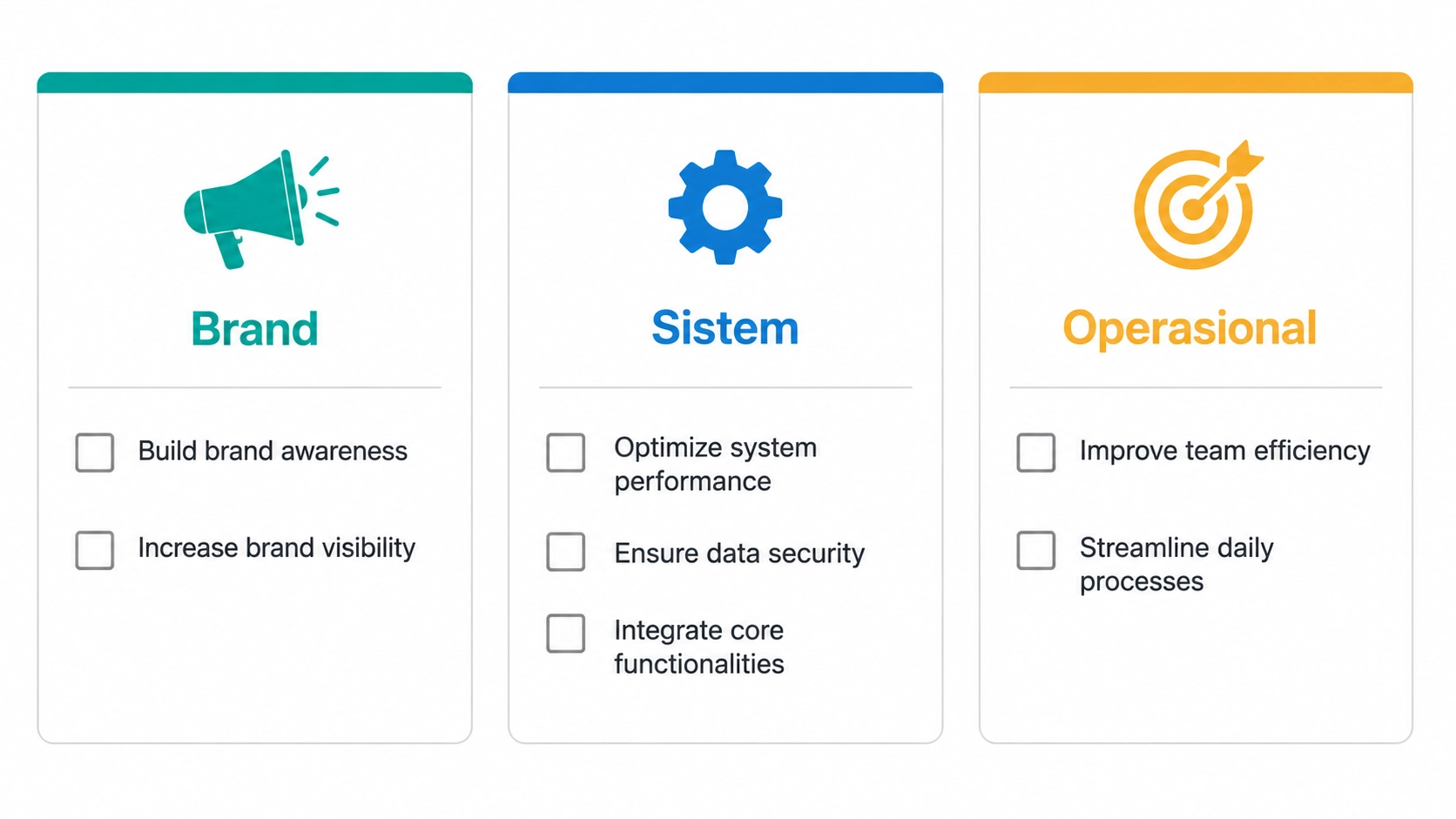
Brand:
- Decide on your WhatsApp username — align it with Instagram and TikTok
- Check naming consistency across: website, Instagram, TikTok, Telegram, WhatsApp
Systems:
- Assess whether your CRM can manage multiple identity types per customer
- Assess whether your helpdesk can link username + BSUID + phone number to one profile
- Review whether your marketing automation flows can accommodate new identity types
Operations:
- Start planning toward a unified customer view
- Follow WhatsApp's official announcements for rollout timing
Where SaleSmartly Stands
SaleSmartly has completed backend BSUID integration and is actively tracking WhatsApp's identity system updates.
At this stage, WhatsApp has only opened backend BSUID capability — the front-end display isn't live yet, so the BSUID information isn't visible in the interface. Once WhatsApp enables front-end access, SaleSmartly will complete the full product update: linking username, BSUID, and phone number into one unified customer profile, so your CS team always sees the complete picture — regardless of which channel a customer came from.
Summary
Usernames make it easier for customers to find you. BSUID determines whether your system can recognize them.
Going forward, you'll need to manage customer identity across multiple layers:
- Username — the entry point customers use to find you
- BSUID — the identifier your system uses to recognize them
- Phone number — verification and account infrastructure
- Multi-platform accounts — the channels where behavior happens
The real change: one phone number used to be enough to know who you were talking to. Soon, you'll need to connect multiple threads. The earlier your systems are ready, the smoother the transition.
FAQ
Can I change my WhatsApp username later?
Yes, but there's a real cost: any links you've shared and any handles customers have saved will point to the old name. Treat it like a domain name — think it through from the start, and don't change it lightly.
Can BSUID be used for cross-business user analysis?
No. BSUID is business-isolated — it's only valid within your own system. Different businesses see completely different BSUIDs for the same person, and there's no way to connect them across companies.
Can I use BSUID to look up a customer's phone number?
No. BSUID contains no phone number data and cannot be reverse-engineered. This is by design — WhatsApp's privacy architecture ensures businesses can't trace a system ID back to a real identity.
If the same customer contacts me via WhatsApp, Instagram, and Tokopedia, will the system recognize them as one person?
Not automatically. That requires your system to have cross-channel identity merging capability — actively linking data from multiple entry points to one customer profile. Without it, the system treats them as three different people.
Can BSUID be used directly for marketing outreach?
It's not designed for direct outreach — it's a system-level identifier, not a contactable field. Standard practice is to map BSUID to your internal customer ID first, then apply tags and run automation from there.
If a customer deletes WhatsApp and re-registers, does their BSUID stay the same?
Most likely it changes. BSUID is tied to the specific relationship established when the customer first contacted your business. A new account registration typically generates a new BSUID, and the previous history won't carry over automatically.
What Can AI Actually Do in Customer Service?
AI is reshaping customer service with 24/7 automated replies, intelligent conversation routing, and more personal customer experiences. See how SaleSmartly applies AI.
Top 10 Telegram Bots in Indonesia in 2026 (Ready-Made and Built-In)
The best Telegram bots in Indonesia for 2026: 7 ready-made bots you add in seconds, plus 3 platforms to build your own business bot.
