Omnichannel vs Multichannel: What Is the Difference?
Most businesses today sell and talk to customers in more than one place, from a website and Instagram to WhatsApp and a physical store. But being present on many channels is not the same as connecting them. The difference between omnichannel and multichannel comes down to whether those channels work in isolation or as one system. This guide defines each term, compares them side by side, and explains how to choose.
What You Need to Know About Multichannel
Multichannel means your business shows up in multiple places at once, email, social media, WhatsApp, a website, a physical store, but each of those places runs on its own. There is no shared data, no connected profile, and no handoff between channels. It is the starting point for most businesses, effective for reach, but limited when a customer moves between touchpoints and expects the experience to follow them.
What Is Multichannel?
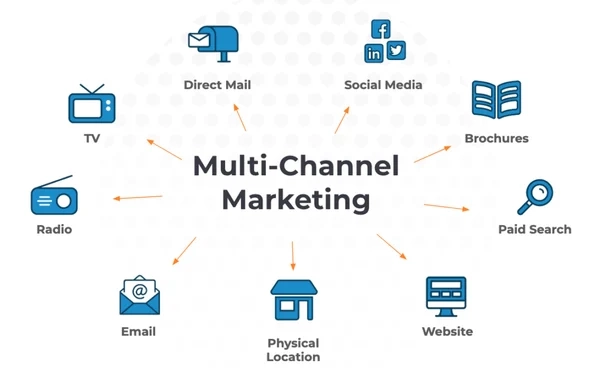
Multichannel is a strategy where a business engages customers across several separate channels, such as email, social media, a website, SMS, and a physical store, with each channel operating independently.
The goal of multichannel is reach, meaning the idea is to be present wherever customers might be, casting a wide net so the brand appears on as many platforms as possible. Each channel runs on its own terms, with its own strategy, its own metrics, and its own messaging, which makes the approach straightforward to launch one platform at a time.
How Multichannel Works
In a multichannel setup, each channel is a self-contained unit. The email platform, the social accounts, and the point-of-sale system each collect their own data and rarely share it, so a customer's activity in one place is invisible to the others.
Multichannel focuses on customer experience because the channels do not talk to each other. For example, someone might receive a promotional email for a product they bought in-store that same morning, or have to re-explain their issue when they move from Instagram to a website chat. The business optimizes each channel's own performance rather than the journey across them, which drives visibility but loses context whenever a customer switches touchpoints.
- Brand at the center: The focus is pushing the brand outward to as many places as possible.
- Siloed data: Information collected on one channel is not shared with the others.
- Channel-specific goals: Success is measured per channel, such as email open rate or social engagement.
- Independent operations: Each channel is often run by a separate team with its own plan.
What You Need to Know About Omnichannel
Omnichannel uses the same channels as multichannel, but connects them into one system, so every touchpoint shares the same customer data in real time with the goal is to optimize time, boost time & efficiency through a continuous process.
What Is Omnichannel?
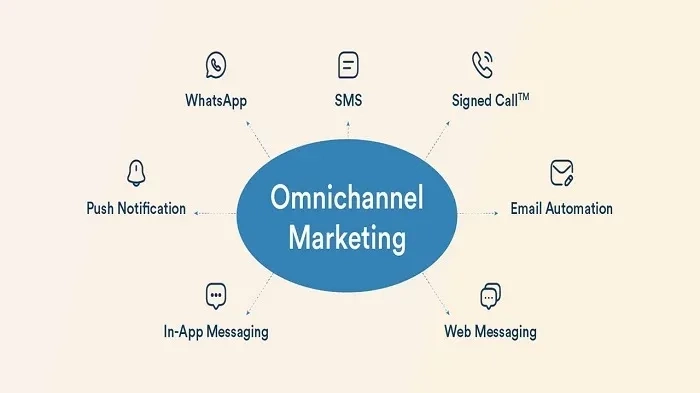
Omnichannel is a strategy that integrates all of a business's channels into one connected system, so the customer moves between them seamlessly without losing context or repeating information.
Where multichannel is brand-focus, omnichannel focuses on user-focus experiences. The channels become delivery mechanisms for one continuous experience, informed by centralized, real-time data. The measure of success is no longer how each channel performs alone, but how smoothly a customer travels across all of them.
How Omnichannel Works
Omnichannel works by unifying customer data into a single profile that every channel reads from and writes to. An action a customer takes on one channel instantly updates that profile, so the next interaction, on any channel, picks up exactly where they left off.
For example, someone might discover a product through a social ad, research it on a mobile site, add it to a cart in an app, and buy it in a store, all as one journey. In an omnichannel setup none of that context is lost, because each touchpoint recognizes the same customer and their full history. A support conversation can pass from a chatbot to a human agent without the customer starting over, which is the clearest everyday sign of omnichannel working.
- Customer at the center: The focus is the quality and continuity of the whole journey.
- Unified data: A single customer profile updates in real time across every channel.
- Seamless messaging: What a customer sees adapts based on their earlier interactions elsewhere.
- Connected operations: Channels hand off to one another instead of working in isolation.
In customer communication, this connected model increasingly relies on automation, and knowing the types of chatbots available helps a business decide how to link its channels into one experience.
Omnichannel vs Multichannel: What's The Difference?
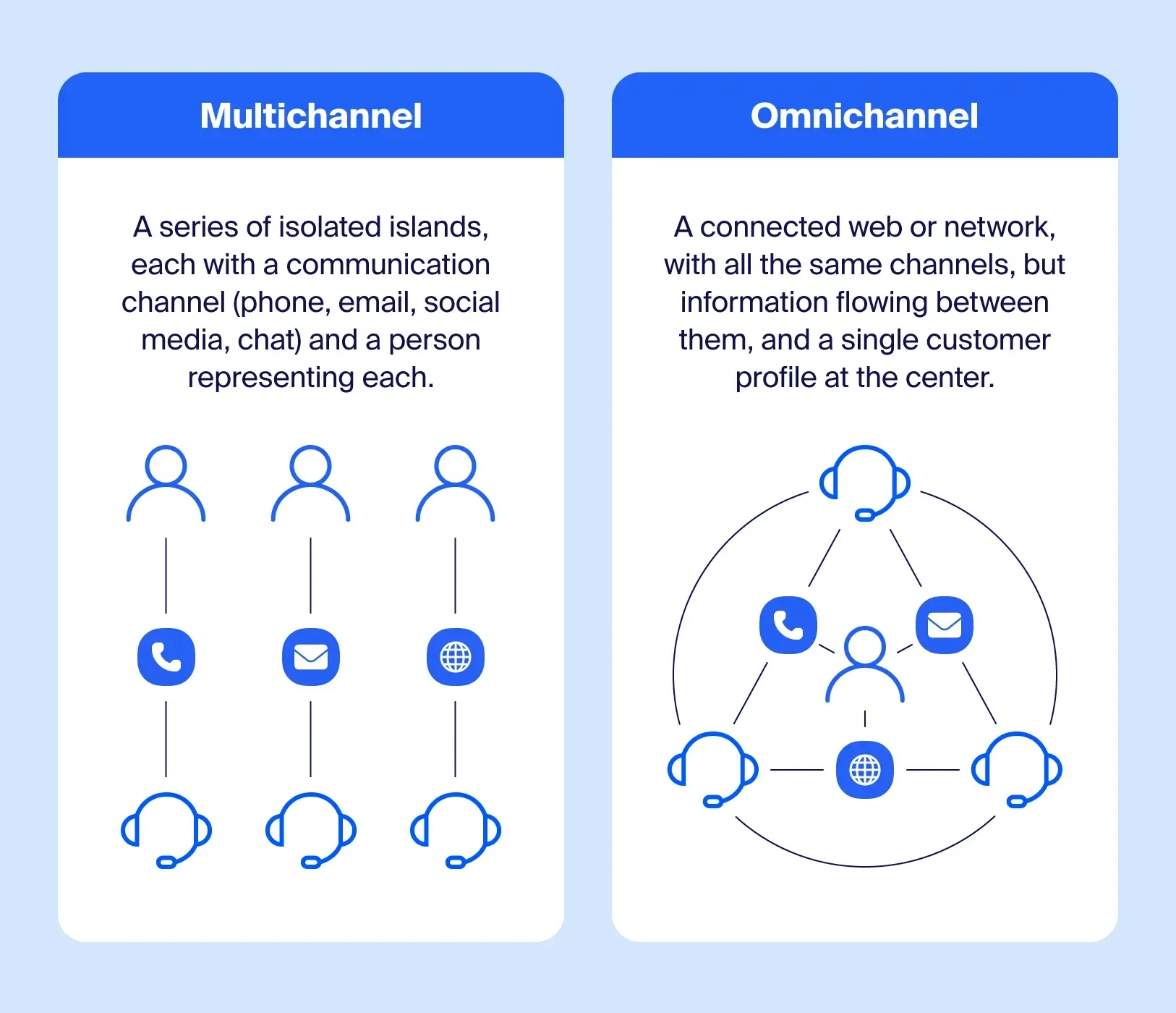
Both strategies use multiple channels, but they differ on integration and intent. Multichannel radiates the brand outward to unconnected channels; omnichannel connects every channel around the customer, check the comparison table below:
| Aspect | Multichannel | Omnichannel |
|---|---|---|
| Main focus | Maximize reach and brand presence | Optimize the whole customer journey |
| Channel integration | Separate and independent | Connected in one central system |
| Customer data | Siloed within each channel | Unified and synced in real time |
| Customer experience | Can feel disjointed; may repeat information | Seamless; context carries across channels |
| Center of strategy | The brand and the product | The customer |
| Setup effort | Lower; run each channel separately | Higher; needs integrated data and tools |
In summary, the two approaches differ on a few core points:
- Integration: Multichannel channels run separately, while omnichannel channels share one connected system.
- Data: Multichannel keeps data siloed per channel; omnichannel unifies it in real time.
- Focus: Multichannel centers on the brand and reach; omnichannel centers on the customer journey.
- Experience: Multichannel can feel disjointed; omnichannel feels seamless across every touchpoint.
- Effort: Multichannel is easier to start; Omnichannel needs more integration but builds deeper loyalty.
Which Approach Is Right for Your Business?
The right choice depends on your team size, technical maturity, and how far your customers move between channels.
| Your situation | Best fit |
|---|---|
| Small team, building a digital presence | Multichannel — cheaper and simpler to start |
| Customers move between channels and expect continuity | Omnichannel — builds loyalty and retention |
| No integrated data or tools yet | Start multichannel, plan omnichannel gradually |
Research by Aberdeen Group shows businesses with strong omnichannel engagement retain 89% of customers, compared to just 33% for those with weak omnichannel. Yet Zendesk CX Trends 2026 reports only 14% of organisations describe their integration as fully connected, so most businesses are still building toward it — and starting with multichannel while planning gradually is the sensible path.
How SaleSmartly Supports an Omnichannel Approach
For customer communication specifically, omnichannel means every conversation lands in one place with full context, not scattered across separate apps and agents. SaleSmartly delivers exactly that:
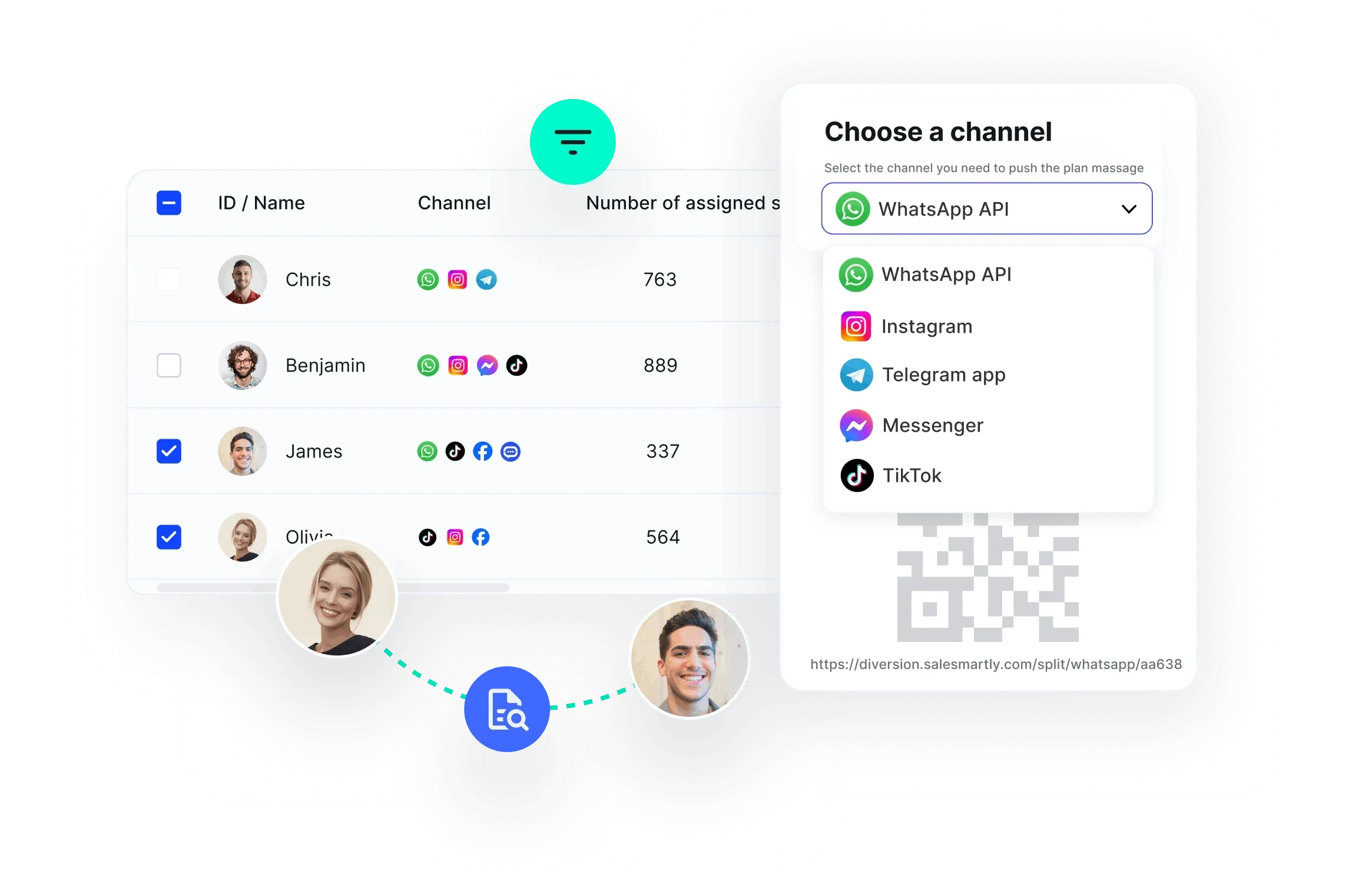
- One inbox for every channel: Messages from WhatsApp, Instagram, Facebook, and web chat arrive in a single shared inbox.
- One profile per customer: A unified profile is built from the conversation itself, so no one starts from scratch.
- No repeating across channels: Whoever replies sees the full history, so the customer never re-explains when they switch channels.
- Instant, context-aware replies: Automated answers and routing sit on top, giving each customer a fast reply wherever they message from.
Want to bring every customer's conversation into one connected inbox? Talk to the SaleSmartly team on WhatsApp to see how.
Conclusion
Multichannel and omnichannel both mean using several channels, but the difference between them is integration. Multichannel spreads the brand across independent channels to maximize reach, while omnichannel connects those channels around the customer to deliver one seamless, continuous experience.
Neither is automatically better; The right choice depends on your goals and resources. Multichannel builds a broad presence and is easier to start, while omnichannel builds loyalty through a unified journey and is worth the investment once customers expect continuity. For most growing businesses, the path runs from one to the other, connecting the channels you already use into a single experience your customers can feel.
FAQs
Is omnichannel better than multichannel?
Not automatically. Multichannel is simpler and cheaper to run, making it a practical starting point for smaller teams focused on reach. Omnichannel requires integrated data and tools but builds stronger loyalty through a seamless experience. The better choice depends on your resources and whether your customers expect continuity as they move between channels.
Can multichannel become omnichannel?
Yes. Multichannel is often the stepping stone to omnichannel. A business can evolve by connecting its existing independent channels, investing in unified customer data and automation so that information flows between touchpoints. The channels you already use stay the same; what changes is that they start sharing one customer view instead of working in isolation.
What is another term for omnichannel?
Unified commerce is the closest alternative term, particularly in retail. Some also use "seamless commerce" or "integrated customer experience," though omnichannel remains the most widely used term in marketing and customer service.
What Is CRM Marketing? Guide, Examples & Strategy (2026)
Discover what CRM marketing is, real examples, key differences from marketing automation, and a 5-step strategy tailored for SMB marketing teams in SEA.
What Are the Functions of a Chatbot? A Practical Guide
A practical guide to the functions of a chatbot, the technology that powers it, and real examples of chatbots at work in business.
