What Is Omnichannel CRM? A Complete Explanation for 2026
This guide covers what an omnichannel CRM is, how it works, and how it differs from multichannel and traditional CRMs. It also walks through the main features to expect, the measurable benefits, and four practical steps for choosing the right platform for your business.
Key Takeaways
- Omnichannel CRM is a unified system that puts customer data, conversations, and workflows from WhatsApp, Instagram, email, live chat, phone, and every other channel into one 360° customer profile that any agent can open.
- Omnichannel CRM connects every channel so context and conversation history follow the customer across every touchpoint, while multichannel CRM runs each channel separately and leaves gaps between them.
- Businesses using omnichannel service reach 67% CSAT compared with 28% for multichannel setups, cut wait times by 39%, and reduce service costs by up to 35% according to industry research.
What Is Omnichannel CRM?
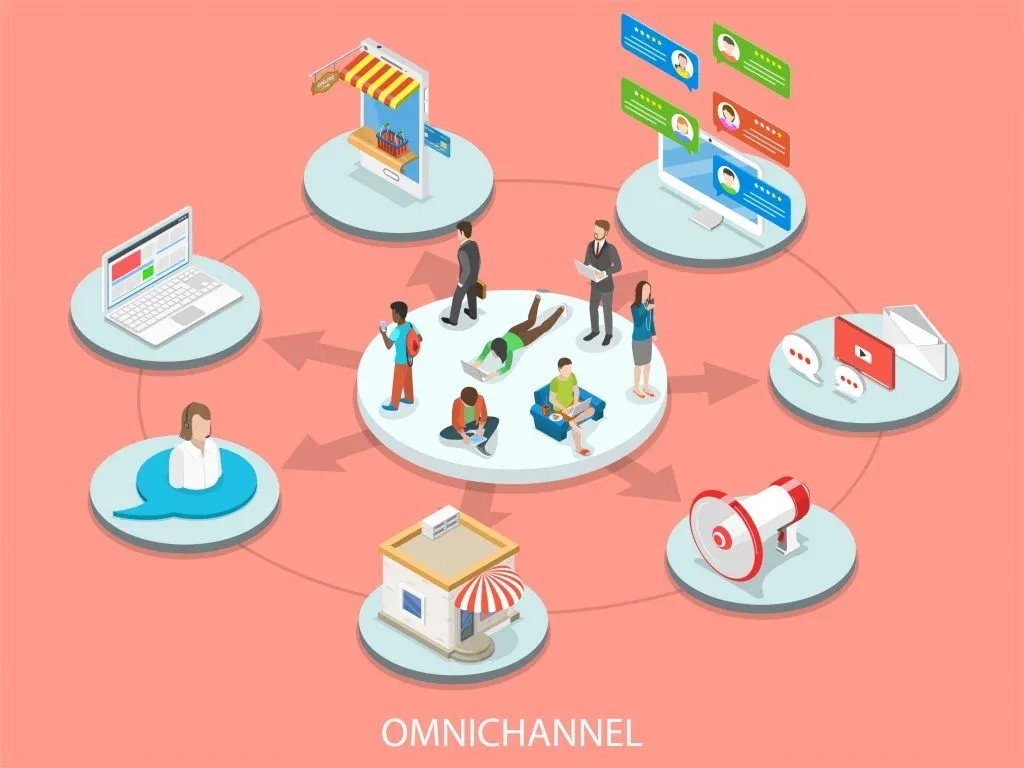
An omnichannel CRM is a unified system that pulls customer data and interactions from every communication channel into one place, giving businesses a real-time, 360° view of every buyer. Whether the first message comes in on WhatsApp, Instagram, email, live chat, phone, or a physical store touchpoint, the record stays connected.
How Omnichannel CRM Works
An omnichannel CRM unifies customer data, communication channels, and workflows into a single platform so businesses can manage interactions seamlessly across every touchpoint. It works through five connected layers that gather signals from every channel, match them to a single customer profile, route each conversation to the right response, and turn the interaction data into insights.
- Data Unification & Identity Resolution: The system uses APIs and native integrations to gather signals from emails, chats, purchases, social DMs, and phone calls, then matches them to a single customer profile using identifiers like email address, phone number, or logged-in account ID.
- Channel Syncing & Unified Inbox: All incoming messages from WhatsApp, Instagram, Facebook Messenger, TikTok, email, live chat, SMS, and other apps pool into one central dashboard, so agents reply across channels without switching tabs or logging into separate tools.
- Context Retention & Continuity: When a customer switches from one channel to another, such as moving from a WhatsApp chat to a phone call, the CRM stitches every interaction into a continuous timeline, so the customer never has to repeat themselves and the next agent sees the full history.
- Intelligent Routing & Automation: The platform evaluates each incoming inquiry by urgency, language, product line, or customer tier, then automatically routes it to the best-suited human agent or AI assistant and fires follow-up sequences based on customer behavior across channels.
- Actionable Insights & Analytics: The system combines interaction data with sales and support metrics to give teams a 360-degree view of every buyer, which powers reporting on response time, resolution rate, and CSAT while feeding personalization for future campaigns.
Omnichannel CRM vs Multichannel CRM vs Traditional CRM: What's The Difference?
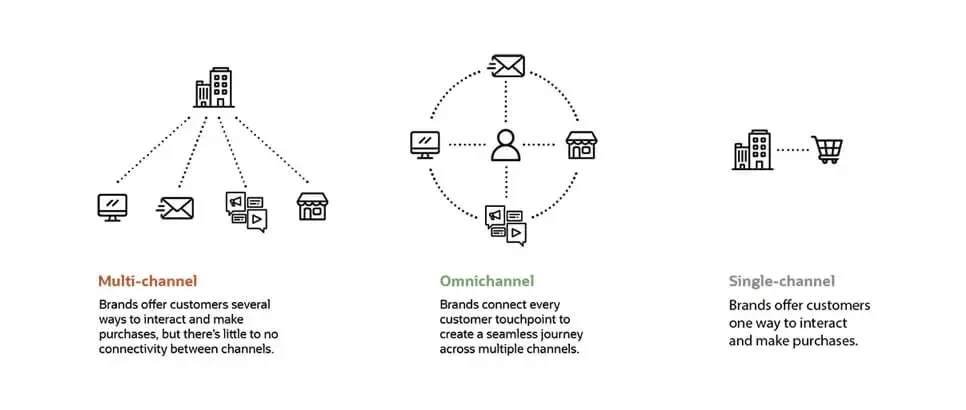
The main difference is how well the channels connect. Traditional CRM stores contact records and tracks basic interactions. Multichannel CRM adds several channels running side by side but separately. Omnichannel CRM connects those channels into one unified experience where customer information flows freely between every touchpoint.
| Dimension | Traditional CRM | Multichannel CRM | Omnichannel CRM |
|---|---|---|---|
| Primary purpose | Store contact data, track deals | Support several channels, each managed separately | Connect every channel into one continuous customer journey |
| Customer view | Static contact record | Fragmented across channel-specific tools | Real-time 360° profile that updates as the customer moves |
| Data flow | Isolated in the CRM | Siloed per channel | Shared across all touchpoints in real time |
| Agent experience | Manual data entry from calls and emails | Switch tabs between channel tools | One workspace with full context on every conversation |
| Best fit for | B2B sales teams focused on pipeline | Businesses starting to add digital channels | Chat-led retail, eCommerce, hospitality, and services |
The three types of CRM work differently in four ways that matter every day.
- Full conversation history: Only omnichannel CRM keeps the complete conversation history across channels, so an Instagram DM and a follow-up WhatsApp message stay part of the same thread.
- Less manual work for agents: Traditional and multichannel setups force agents to sort messages and switch between tools by hand, while omnichannel routes each message and shows context automatically.
- No repeated questions for customers: Buyers in a traditional or multichannel setup often have to repeat themselves at every step. Omnichannel removes this problem completely.
- Combined analytics: Omnichannel dashboards blend performance from every channel into one view, while the other two report per channel and leave leaders combining the numbers by hand.
For a deeper breakdown of the two most-confused models, our guide on the difference between omnichannel and multichannel covers the technical and operational gaps in detail.
Key Features To Expect From An Omnichannel CRM
A capable omnichannel CRM ships with six main features that turn every incoming conversation into a workable operation. Unified inbox, 360° customer profiles, workflow automation, AI-assisted responses, cross-channel analytics, and open integrations form the baseline. Anything missing from this list is a red flag during evaluation.
- Unified inbox across every channel: Messages from WhatsApp, Instagram DMs, Facebook Messenger, TikTok, email, live chat, phone, and regional messengers come into one shared workspace. Our overview of Telegram bot integration shows how a local channel plugs into that same inbox without breaking the flow.
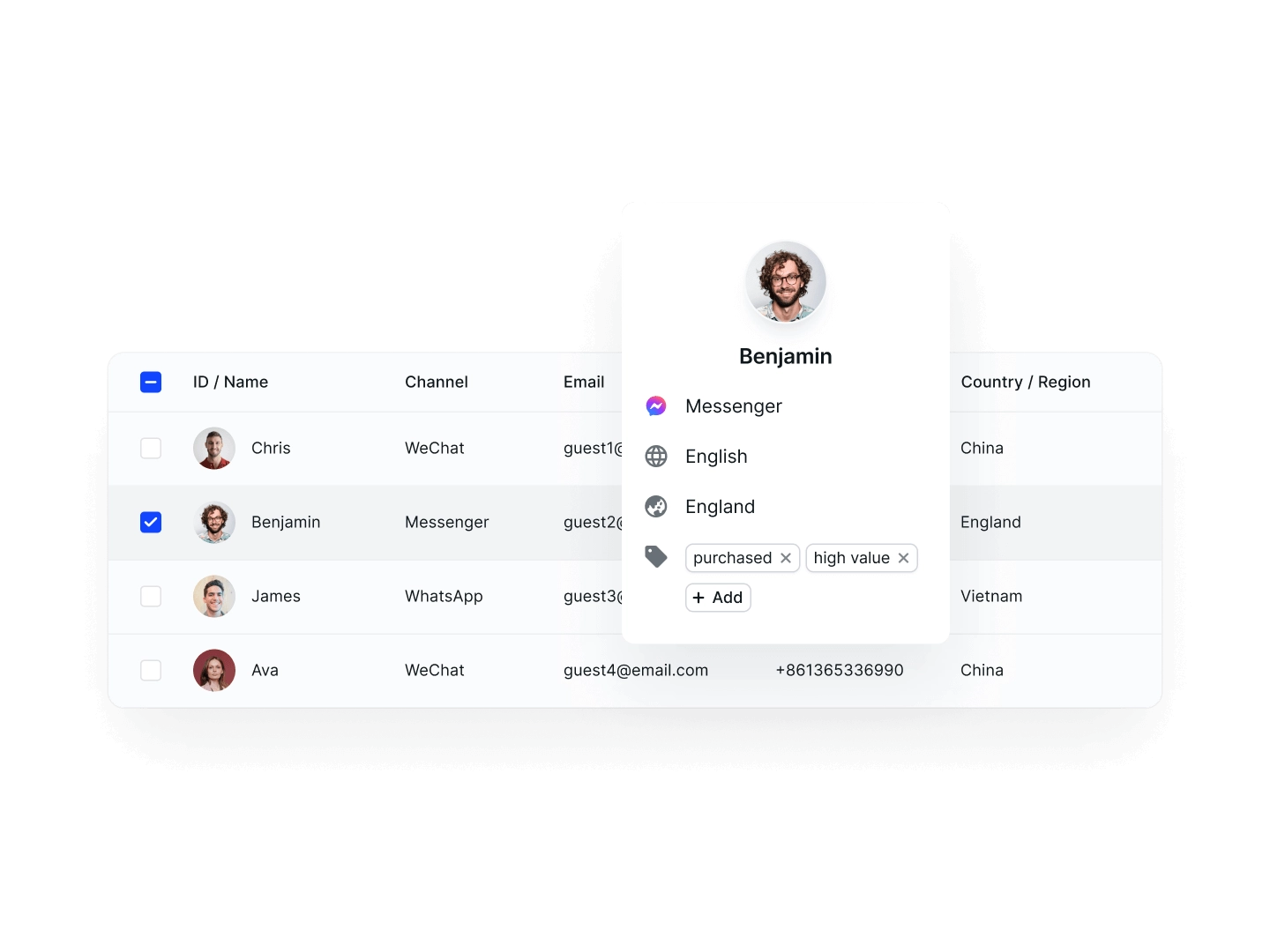
- 360° customer profile: Every profile carries the full history of past conversations, orders, notes, tags, and stated preferences. Agents open the record and see the story, so no one starts a reply from zero.
- Workflow automation and smart routing: Rules assign new conversations by language, product line, VIP status, or team availability. Automated follow-ups fire based on customer behavior across channels, not just from a single trigger.
- AI-powered responses and agent assist: AI agents qualify inbound leads, answer common questions instantly, and hand off to a human when the query gets complex. The best setups make this switch feel invisible to the customer.
- Cross-channel analytics: Dashboards blend performance from every channel into one view of response time, resolution rate, conversion, and CSAT. Leaders finally see where the real bottleneck sits.
- Open API and native integrations: The platform connects to your eCommerce store, POS, marketing tools, and ERP. Without this, the CRM becomes another silo the team has to work around.
Benefits of Omnichannel CRM
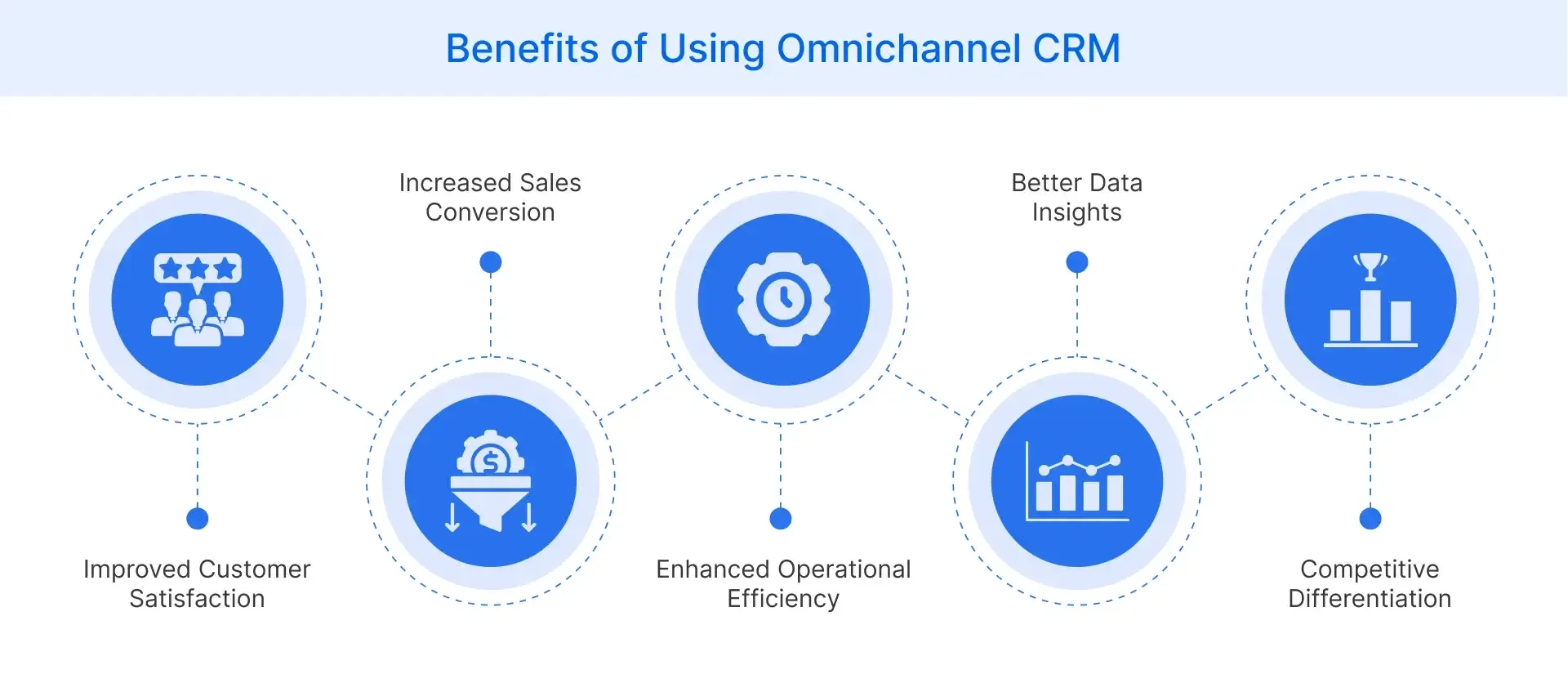
Omnichannel CRM adoption delivers measurable gains in customer satisfaction, retention, revenue, and cost. Businesses that connect their channels see faster response times, more productive agents, better teamwork between sales and service, and clearer visibility for leadership. These gains grow over time as customer data helps you personalize offers and predict what buyers need next.
In fact, the service pushes CSAT scores to 67%, well above the 28% figure recorded for multichannel setups. In addition, companies with connected channels cut wait times by 39% and reduce service costs by up to 35%. Beyond those headline numbers, the main benefits break down across five areas that build on one another over time.
- Faster resolutions with full context: Agents skip the "let me look that up" step because everything sits in one profile. Zendesk's 2025 CX Trends report highlights that keeping the full conversation context is now what customers expect, not a bonus feature.
- Higher retention and loyalty: 35% of firms report better customer retention after adopting omnichannel engagement, and 46% see a lift in customer lifetime value.
- Sales, service, and marketing on the same customer record: Marketing sees which campaigns landed, sales sees the support history, and service sees the buying intent, all from the same record. Our CRM marketing guide dives deeper into how shared record fuels campaign personalization across the funnel.
- Lower operational cost per conversation: Automation handles repetitive questions, routing removes manual sorting, and agents work faster without switching between apps.
- Cross-channel data leadership can actually use: One dashboard across every channel gives founders and CX heads a real read on what is working, where the drop-off happens, and where the next investment should land.
How To Choose The Best Omnichannel CRM Software For Your Business
Identify Your Communication Channels
Start with the channels your customers actually message you on, not the ones you assume they use. For most Indonesian businesses, WhatsApp is the top inbound channel, followed by Instagram DMs, Facebook Messenger, TikTok DMs, email, and live chat. Once you have that list, ask the vendor to prove three things during the demo.
- Official API access: Confirm the CRM uses the official WhatsApp Business API through a Meta-approved BSP. Unofficial WhatsApp Web scrapers get banned by Meta enforcement and take your business number down with them.
- Automatic contact merging: When a buyer who messaged on WhatsApp last week sends an email today, the platform should recognize the same phone number or email and merge both into one profile, not create two separate records.
- A real conversation timeline: The customer view should show the actual message thread from every channel in order, not just a summary or a ticket count.
Match Features To Your Business Size And Type
Every CRM category has a sweet spot, and matching your business type to the right one prevents overpaying or outgrowing the platform within a year.
- Small businesses and startups: Look for a free tier or a low entry price, setup you can complete without a consultant, and ready-made templates for common workflows like lead intake and welcome messages. HubSpot CRM offers a free plan covering contact management, deal tracking, and basic email automation, while Zoho CRM provides a low-cost entry tier with WhatsApp integration.
- Sales-driven teams: Prioritize visual pipelines, deal-stage automation, activity tracking, and email sync. Pipedrive covers most SMB sales workflows out of the box, with WhatsApp, phone, and SMS available through native or marketplace integrations.
- Large enterprises: Look for deep customization, advanced security controls, multi-region support, and role-based access at scale. Salesforce Service Cloud handles complex multi-department operations but usually needs a dedicated admin plus a three-to-six month setup period.
- Chat-led SMBs in Southeast Asia: Look for platforms built around WhatsApp Business API access, Instagram, and TikTok as first-class channels, with CRM records that build up from actual conversations. This category usually bundles the CRM with WhatsApp Business API messaging under one contract.
Evaluate Integration And Automation Depth
Confirm the CRM connects natively to the exact tools your team already uses. For Indonesian eCommerce and retail teams, that usually means Shopify, WooCommerce, Tokopedia, Shopee, or Lazada, plus an accounting tool like Jurnal or Xero and a marketing platform like Mailchimp. Then test the automation layer during the demo with three specific asks.
- Language-based routing: Ask whether the CRM can send an incoming WhatsApp message in Bahasa Indonesia to a Bahasa-speaking agent, and an English message to an English-speaking agent, without paying extra.
- Behavior-triggered follow-ups: Ask whether it can send a WhatsApp reminder when a customer views a product page but does not add to cart within 24 hours.
- AI qualification with clean handoff: Ask whether the AI agent can run a five-question qualification conversation and hand off to a human once the lead hits a set threshold, with the full conversation history visible to the human agent.
Answers that need a paid connector or an outside tool for every trigger recreate the same problem the CRM should solve.
Calculate Total Cost Of Ownership
The subscription fee on the vendor's pricing page is usually only part of what you will pay in year one. Plan for the four extra costs below before signing any contract.
- Implementation and onboarding: SMB deployments generally take 6 to 8 weeks and may include a paid onboarding package for setup, template configuration, and initial training.
- Data migration: Cleaning and importing contacts from your existing spreadsheet or CRM is often billed by the hour, especially if records have duplicates or missing fields.
- WhatsApp Business API messaging fees: Meta bills per message in Indonesia, with marketing messages currently around Rp586 and utility or authentication messages around Rp357 each, plus 11% VAT. Customer-initiated service replies inside the 24-hour window remain free through 2026. Your BSP or omnichannel platform adds a small markup on top.
- Premium modules and extra seats: AI agent seats, advanced reporting, and additional users are usually separate charges that grow with team size.
Our CRM software buyer's guide breaks down the pricing patterns to expect across the category.
How SaleSmartly Powers Omnichannel Customer Communication
Most omnichannel CRMs treat conversation as a side product of managing the sales pipeline, which works for enterprise sales teams but leaves chat-led businesses building workarounds.
SalesSmartly takes the opposite approach. We build the customer record from the conversation itself, which fits how Indonesian and Southeast Asian buyers actually shop, through WhatsApp, Instagram DMs, TikTok, Facebook Messenger, and Telegram, long before they ever fill out a website form.
Our platform delivers:
- A* *unified inbox** for WhatsApp, Instagram, Facebook Messenger, TikTok, Telegram, LINE, email, and live chat: Cloud-hosted Zalo access via QR code covers Vietnamese buyers.
- CRM records built directly from conversations: Tags, order history, and notes build up as the relationship develops, so profiles stay accurate over time.
- AI agents with clean human handover: The moment a query needs judgment, the conversation moves to a live agent without the customer noticing.
- Cross-channel analytics: Response time, resolution rate, and team performance all report against one view of the buyer.
SaleSmartly is built specifically for chat-first customer communication. We do not replace a full sales pipeline platform, and we are not the right fit for specialized banking or insurance systems. For businesses whose customers live in WhatsApp, Instagram, and other messaging channels, our platform handles every conversation from the first message to a long-term customer relationship.
Message us on WhatsApp for a walkthrough tailored to your team's workflow.
FAQs
Is omnichannel CRM only for large enterprises, or do SMBs actually benefit?
No. Small and mid-sized businesses often see the fastest gains, because modern SaaS platforms have brought pricing down to a point where a team of three to five people can connect their most-used channels without an enterprise budget. The practical starting point is to identify the two channels your customers use most and build from there.
How long does CRM implementation typically take?
About 6 to 8 weeks for an SMB rolling out an omnichannel CRM on cloud infrastructure, and 4 to 8 months for larger operations with legacy phone systems or fresh WhatsApp Business API onboarding. The most common delays are Meta Business Manager verification and messy contact data that needs cleaning before migration.
Can an omnichannel CRM work alongside my existing sales pipeline tool?
Yes. Most modern omnichannel CRMs offer native integrations or open APIs that sync contacts, deals, and notes with pipeline platforms like Salesforce, HubSpot, or Pipedrive. The omnichannel platform handles conversation and context, the sales CRM handles pipeline and forecasting, and both share a live customer record.
What Is a CRM System and How Does It Actually Work?
Discover what a CRM system is, how it works, main types, benefits with real costs, common challenges, and the top 5 CRM platforms for Indonesian SMBs.
What Is CRM Marketing? Guide, Examples & Strategy (2026)
Discover what CRM marketing is, real examples, key differences from marketing automation, and a 5-step strategy tailored for SMB marketing teams in SEA.
