Types of Chatbots: How to Choose the Right Platform for Your Business
Not every chatbot is built the same, and choosing the wrong type is a common, costly mistake. A simple menu bot frustrates customers who want real answers, while an advanced AI system is overkill for a business that only needs to handle a handful of FAQs.
In this guide, we explain different types of chatbots, what each one does well, and how to match the right type to your business needs.
What Is a Chatbot, and Why Do Businesses Use One?
A chatbot is a software tool that simulates human conversation to answer questions and complete tasks automatically, through text or voice.
Businesses adopt chatbots because they solve a problem that scales badly with people alone: repetitive conversations. The core benefits are consistent across every type:
- Round-the-clock availability: Customers get answers at any hour without waiting for an agent.
- Faster response times: Common questions are resolved instantly, cutting queues and abandonment.
- Lower support costs: Automating routine volume reduces the load on human agents.
- Scalability: A chatbot handles hundreds of simultaneous conversations without added headcount.
- Consistency: Every customer receives the same accurate information, every time.
What Are the Main Types of Chatbots?
Chatbots fall into six recognized categories, distinguished by how they understand and respond to users. The chatbot types range from basic menu-driven bots to generative AI systems that create original responses.
Menu or Button-Based Chatbots
The most basic type, a menu-based chatbot guides users through a series of clickable buttons rather than open text. Each choice leads to another set of options, working like a decision tree until the user reaches the answer they need. You have almost certainly used one when tracking an order or navigating a support page.
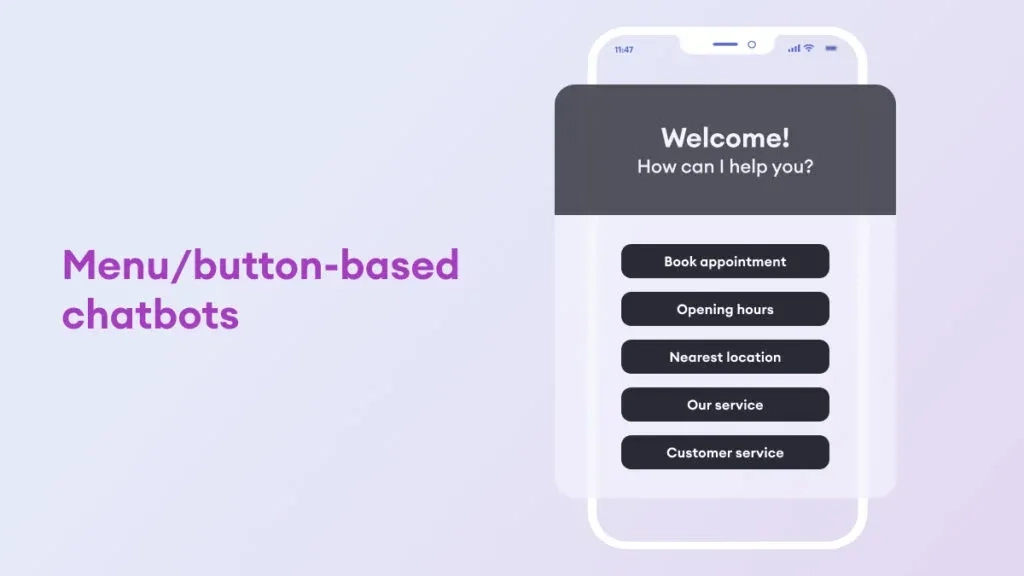
This type works well for simple, predictable tasks but breaks down the moment a customer needs something outside the preset menu, since there is no field to type a free question.
- Decision-tree navigation: Guides users step by step through fixed options.
- No free-text input: Users select rather than type.
- Fast to build: Requires no AI or training data.
Best used for: Simple, transactional tasks such as store hours, basic FAQs, or menu navigation.
Example tools: Most website help widgets and basic Facebook Messenger flows.
Read more:
Rule-Based Chatbots
Building on the menu model, a rule-based chatbot uses "if-then" logic and basic keyword detection to respond. A designer programs set question-and-answer pairs, so the bot acts like an interactive FAQ, matching a user's input to a scripted reply.
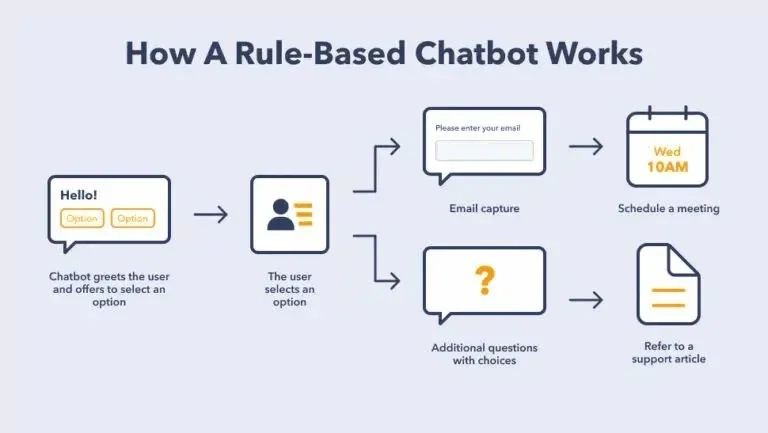
These bots are easy to set up and reliable for predictable questions like pricing or opening hours. The biggest limitation of rule-based chatbots is rigidity. Any question outside what the designer programmed leaves the bot with no answer, forcing the customer to repeat themselves or wait for a human agent.
- Keyword matching: Triggers replies from recognized words or phrases.
- Scripted flows: Follows pre-written conversation paths.
- Predictable behavior: Reliable within its programmed scope.
Best used for: FAQ automation, lead capture forms, and structured, repetitive queries.
Example tools: Chatfuel, Landbot, and most basic WhatsApp autoresponders.
AI-Powered Chatbots
An AI-powered chatbot uses natural language processing (NLP), the technology that lets software interpret human language, to understand questions no matter how they are phrased. Rather than matching keywords, it grasps intent, asks clarifying questions when unsure, and improves over time through machine learning.
This type handles nuanced, varied conversations that rule-based bots cannot, and it can pull from your business systems to complete real tasks. Because it learns from interactions, its accuracy grows the longer it runs.
For example, AI chatbots like SaleSmartly connect your WhatsApp, Instagram, Telegram, and other channels into one inbox where the AI reads customer intent, replies automatically, and transfers to a human agent with the full conversation history when needed.

- Intent recognition: Understands meaning, not just keywords.
- Self-learning: Improves accuracy through machine learning over time.
- System integration: Pulls order, account, and CRM data to complete tasks.
- Context memory: Remembers earlier messages within a conversation.
Best used for: Customer service at scale, personalized support, and businesses with varied, high-volume queries.
Example tools: SaleSmartly, Intercom Fin, and IBM Watsonx Assistant.
Voice Chatbots
A voice chatbot lets users speak instead of type, using text-to-speech and speech-to-text technology to hold a spoken conversation. Older versions rely on rigid interactive voice response (IVR) menus, but AI-driven voice bots now understand natural speech and reply conversationally.
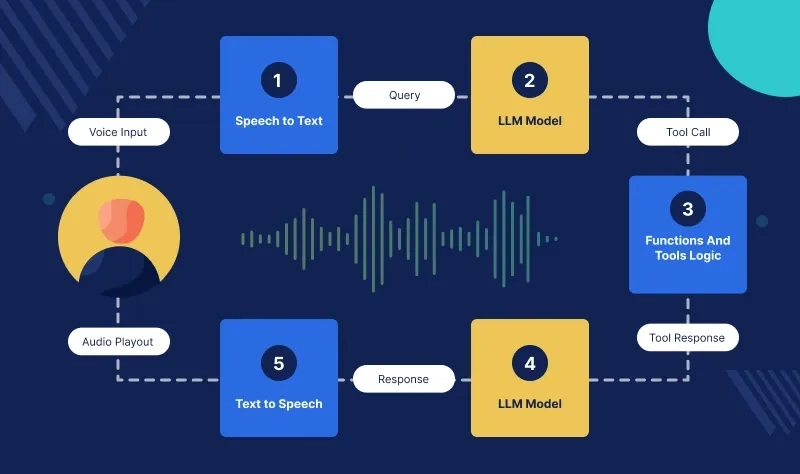
This type suits hands-free and phone-based contexts where speaking is faster than typing. In practice, it delivers quicker real-time answers, though speech recognition still stumbles on heavy accents or noisy environments.
- Speech recognition: Converts spoken words into structured meaning.
- Voice channel deployment: Works over phone lines and smart devices.
- Conversational tone: AI versions reply naturally rather than through rigid menus.
Best used for: Call center automation, phone-based support, and voice assistants.
Example tools: Amazon Alexa, Google Assistant, and Apple Siri.
Generative AI Chatbots
A generative AI chatbot uses large language models, the technology behind tools like ChatGPT, to generate original responses. It understands everyday language fluently, adapts to a user's tone, and can create new text, summaries, or translations on demand.
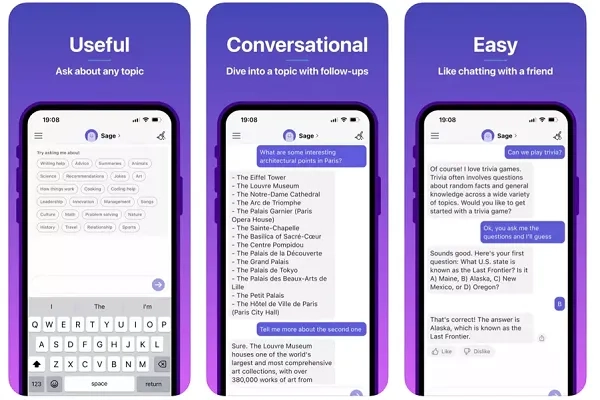
This is the most advanced type, capable of open-ended, human-like conversation. Its strength, generating fresh content, is also its risk: without connection to verified business content, it can produce confident but inaccurate answers, so grounding it in your data matters.
- Content generation: Creates original text, summaries, and translations.
- Fluent, adaptive language: Matches the user's conversational style.
- Broad knowledge: Draws on large language models for wide-ranging responses.
Best used for: Complex support, content-rich interactions, and multilingual service.
Example tools: ChatGPT, Google Gemini, and Claude.
Hybrid Chatbots
A hybrid chatbot combines rule-based logic with AI capabilities, using scripts for structured tasks and AI for open-ended ones. This blend delivers the reliability of predefined flows alongside the flexibility to handle unexpected questions.
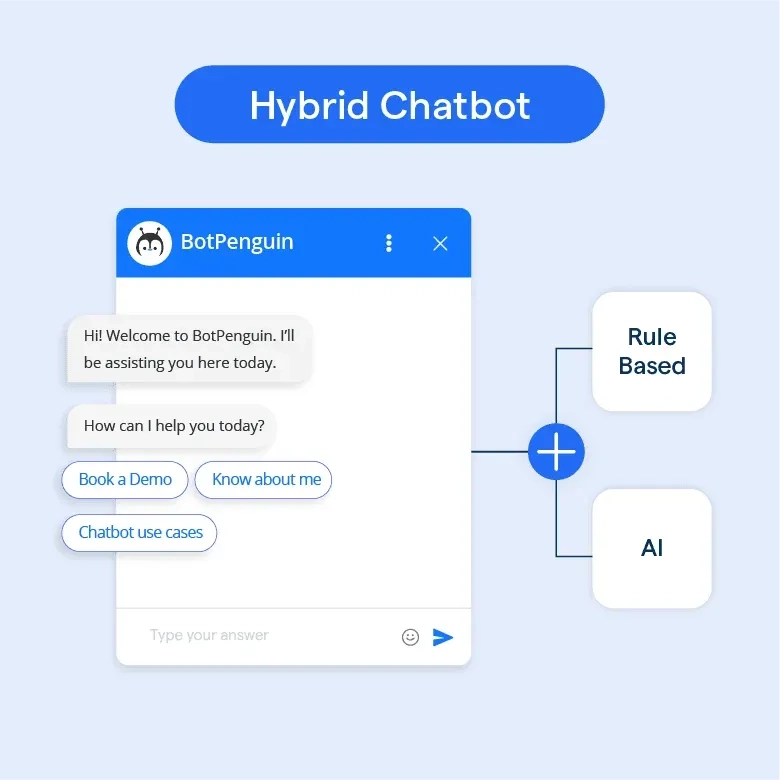
For most businesses, this is the practical sweet spot: predictable processes like booking or order status run on rules, while everything else falls to AI. Many modern platforms are hybrid by design, which is why choosing one often means choosing a hybrid system rather than a pure type.
Teams deploying AI agents for customer service usually land on this model.
- Rules plus AI: Structured flows for routine tasks, AI for nuance.
- Reliable and flexible: Combines predictability with adaptability.
- Smooth handover: Routes to humans when neither rules nor AI suffice.
Best used for: Businesses that need both structured processes and natural conversation.
Example tools: SaleSmartly, Zendesk AI, and most enterprise chatbot platforms.
How Do You Choose the Right Chatbot for Your Business?
The right chatbot depends on your customers' needs, your query volume, and how much your team can maintain. Start with what your customers actually want to do when they contact you:
- If most queries are simple and repetitive — product hours, pricing, basic FAQs — a rule-based or menu chatbot resolves them reliably and launches fastest. Overbuilding here adds cost without improving the customer experience.
- If queries vary and volume is high, a rule-based bot will break down constantly. An AI-powered chatbot reads intent regardless of how a question is phrased, scales without adding agents, and improves over time as it handles more conversations.
- If your customers contact you by phone, a voice chatbot is the natural fit. Forcing them to type when they expect to speak creates unnecessary friction.
- If your service spans multiple languages or requires open-ended answers, a generative AI chatbot handles both. It produces original responses instead of pulling from a fixed library, which matters when no two questions are the same.
- If you need both reliability and flexibility, a hybrid chatbot is usually where businesses land. Structured processes like booking confirmations and order status run on rules, while everything outside that falls to AI.
One factor most teams underestimate is channel fit. A technically advanced chatbot deployed on the wrong platform still loses to a simpler one that lives where your customers already are.
Conclusion
Understanding the types of chatbots turns a confusing buying decision into a clear one. The six types, from menu-based to generative AI, each solve a different problem, and the best choice is the one that fits your customers and your volume, not the most sophisticated system on the market.
For most growing businesses, a hybrid AI approach across the channels customers already use offers the strongest balance of reliability and flexibility. If that describes your setup, SaleSmartly runs an AI chatbot with no-code rules across WhatsApp, Instagram, and more, all from one workspace.
Speak with the SaleSmartly team to test how AI chatbots can elevate your customer experience.
FAQ
What are the different types of chatbots?
There are six main types: menu or button-based, rule-based, AI-powered, voice, generative AI, and hybrid. They differ by how they understand users, from simple button clicks and scripted keywords to AI that grasps intent and generative models that create original responses. Most business platforms today use a hybrid of rules and AI.
What are examples of chatbots?
Everyday examples include voice assistants like Siri, Alexa, and Google Assistant, and generative AI tools like ChatGPT and Google Gemini. For business customer service, platforms such as SaleSmartly, Intercom, and Zendesk provide AI and hybrid chatbots that handle support across messaging channels like WhatsApp and Instagram.
How many types of AI chatbots are there?
Among AI-driven chatbots, there are three main kinds: AI-powered chatbots that understand intent through natural language processing, generative AI chatbots that create original responses using large language models, and hybrid chatbots that combine AI with rule-based scripts. Each offers a different balance of flexibility, control, and conversational ability.
What exactly is a chatbot?
A chatbot is software that simulates human conversation to answer questions or complete tasks automatically, through text or voice. Simple chatbots follow scripts and menus, while advanced ones use artificial intelligence to understand natural language and respond conversationally. Businesses use them to provide instant, around-the-clock support without adding staff.
What Is an AI Chatbot? How It Works, What It Does, and the Best Tools in 2026
What is an AI chatbot, how does it work, and which tools lead in 2026? A clear guide to AI chatbots, their uses, and the evidence behind them.
What Is a Broadcast? How Bulk Messaging Works and How to Do It Safely
What is a broadcast in messaging, how does WhatsApp broadcast differ from a blast, and how do you send bulk messages without getting blocked? A clear guide.
