What Are the Functions of a Chatbot? A Practical Guide
A chatbot answers a customer at midnight, qualifies a lead before your sales team wakes up, and handles a hundred repetitive questions at once without tiring. Those are the real functions of a chatbot, and they explain why the tool now sits at the centre of how businesses handle customer conversations. In this article, we will cover what a chatbot is, its four core functions, the technology that powers it, and how to get the most from it.
What Is a Chatbot?
A chatbot is a computer program that talks with users through text or voice, answering questions and completing tasks automatically without a person handling each reply.
Some chatbots are simple and follow a fixed script to answer set questions. Others use AI to hold a natural conversation and learn as they go. Either way, the goal is the same. The bot gives customers a fast, accurate answer at any hour and takes repetitive work off your team's hands.
What Are the Main Functions of a Chatbot?
A chatbot performs several core functions for a business. It answers customer questions, qualifies leads and supports sales, completes tasks and transactions, automates workflows, and escalates complex cases to a human agent. Most business chatbots combine several of these functions in a single conversation.
The table below summarises each function and the business outcome it drives.
| Function | What it does | Business outcome |
|---|---|---|
| Answering questions | Responds to product, service, and policy questions at any hour | Faster replies, lower support cost |
| Lead qualification and sales | Recommends products and collects customer information | More qualified leads, higher conversion |
| Task completion | Schedules appointments, updates records, processes returns | Less manual work for staff |
| Workflow automation | Creates tickets, routes requests, captures conversation data | Streamlined processes, actionable insight |
| Human escalation | Transfers complex cases with full context | Reliable handling of sensitive issues |
Answering Customer Questions
The most common function of a chatbot is answering routine questions about products, services, and policies, available at any hour. How capably it does this depends on the chatbot type, and the difference is significant.
| Rule-based chatbot | AI chatbot | |
|---|---|---|
| How it responds | Matches input against predefined rules, keywords, and decision trees | Uses natural language understanding (NLU) to interpret intent, then an LLM to generate the response |
| Unfamiliar phrasing | Cannot continue, redirects or transfers the user | Handles varied phrasing, follow-up questions, and context within a conversation |
| Main limitation | Rigid, limited to programmed responses | Can hallucinate, generating a confident but inaccurate answer |
The AI chatbot's limitation is worth understanding technically. Practitioners explaining how these models work describe an AI chatbot as a sophisticated next-word predictor.
The model stores words as numerical values positioned by similarity, so it recognises that "invoice" sits close to "payment" and far from "weather," and it builds a reply by repeatedly choosing the most probable next word for the given context. As developers discussing the technology often summarise it, the model produces convincing language without comprehending what it is saying. That mechanism is exactly why hallucinations occur, since the bot is guessing plausible text, not researching a fact.
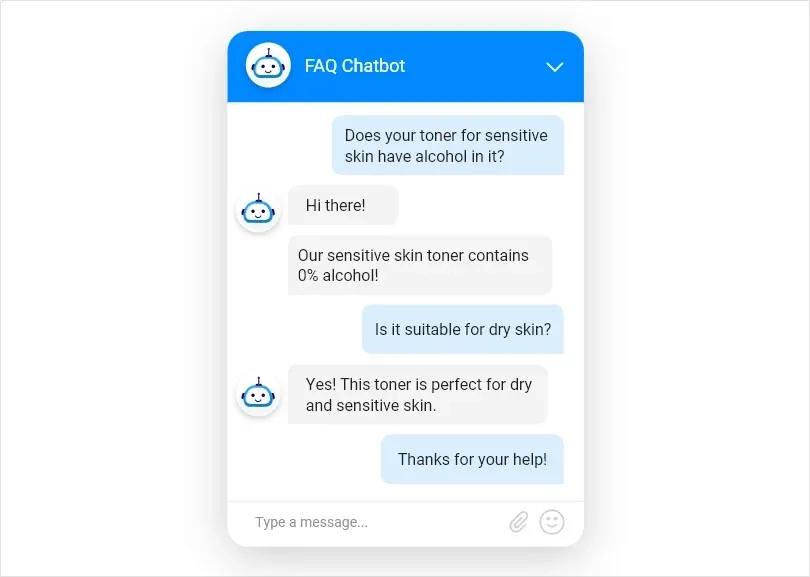
The standard mitigation is retrieval-augmented generation (RAG), which grounds the model's output in your own knowledge base so each answer traces back to verified content. Deployed with that grounding, the results are substantial. Vodafone's IBM-built agent TOBi resolved 70% of customer inquiries independently and reduced cost per chat by 70% across more than 600 million subscribers, as documented in an IBM and Vodafone case study.
Qualifying Leads and Supporting Sales
Chatbots support sales by helping prospective customers learn about products, providing recommendations, and guiding them through the buying process. The mechanism behind this is intent recognition and entity extraction, the NLU functions that let the bot identify what a visitor wants and pull out the specific details, then act on them within the same conversation.
- Answering product questions so a customer gets details without waiting for a representative.
- Recommending products or services based on the intent and entities the NLU layer extracts.
- Qualifying leads by collecting customer information and scoring intent.
- Scheduling meetings or demonstrations directly from the conversation.
Because the chatbot engages a visitor at the point of interest, it captures and qualifies leads that a static form and delayed follow-up frequently lose.
Completing Tasks and Transactions
Beyond answering questions, many AI chatbots complete routine actions by calling APIs into connected business systems. This is the line between a chatbot that informs and one that resolves.
- Informational responses guide a customer to reset a password or track an order themselves.
- Transactional actions call a business system through an API to schedule an appointment, update account information, or process a return end to end.
When a chatbot chains several such steps and decides between them autonomously, it crosses into what IBM defines as an AI agent, a system that plans and executes multi-step workflows with limited human involvement.
Automating Workflows and Capturing Insight
More advanced chatbots automate parts of a business process by collecting information, integrating with other systems through APIs, and completing defined tasks such as creating support tickets, updating records, or routing a request to the right team.
Each conversation also produces structured data on common questions and recurring issues, which surfaces the information gaps a business can act on to improve its products, services, and support resources.
Escalating to a Human Agent
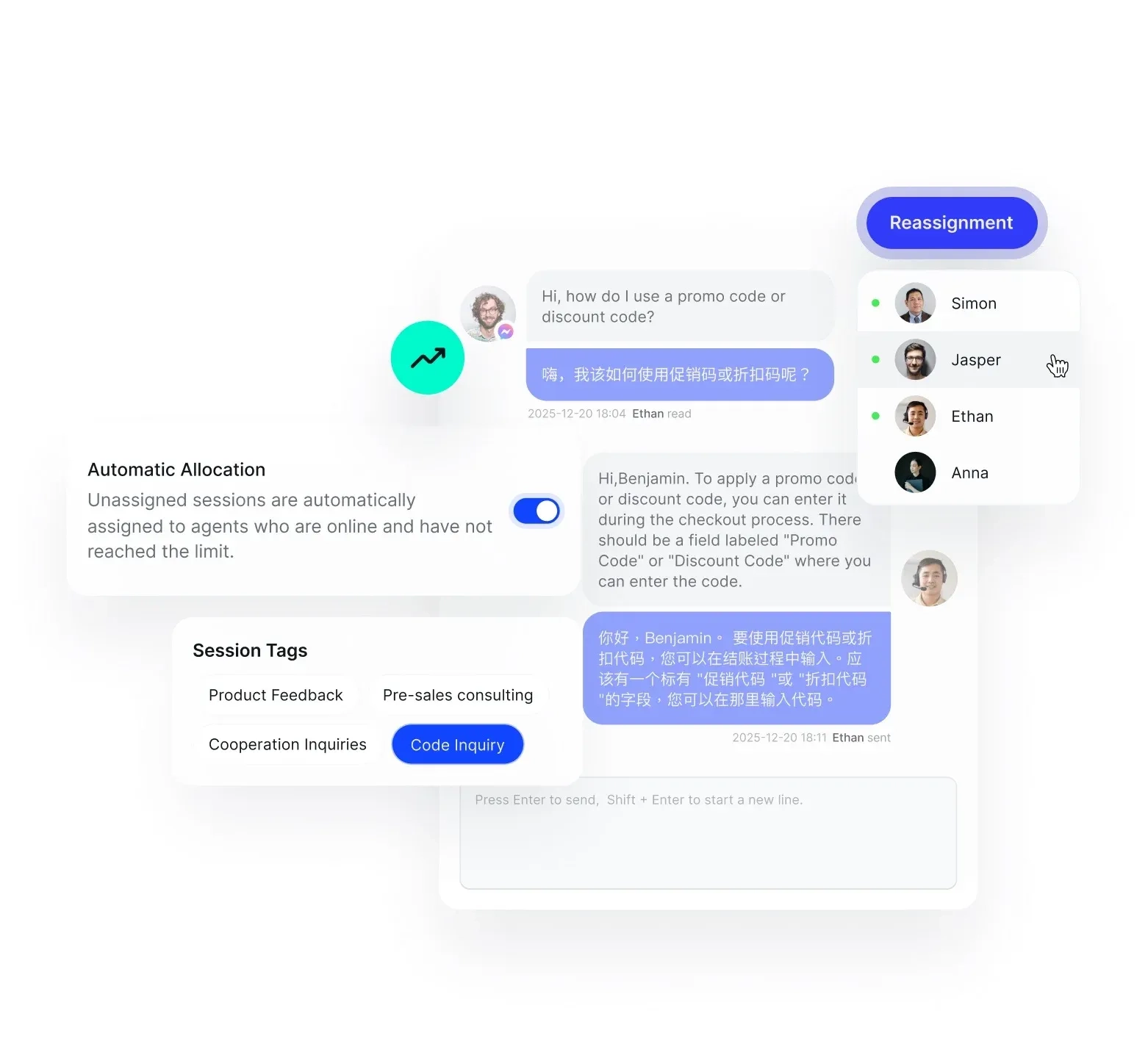
A chatbot cannot resolve every conversation, and some situations call for human judgment, empathy, or specialised expertise. A well-designed chatbot recognises its limitations and provides a clear path to a human representative, transferring the full conversation context so the customer does not repeat themselves. This function is what keeps automation reliable, handling routine requests at scale while ensuring complex or sensitive cases reach a person.
What Technology Powers a Chatbot?
A chatbot runs on a mix of natural language processing, machine learning, and either fixed rules or AI models. These parts let it understand a message and produce a useful reply, and the exact blend decides how naturally the bot holds a conversation.
- Natural language processing (NLP): Reads the customer's words, breaks down the sentence, and works out the intent behind it, so the bot copes with slang, typos, and different phrasings of the same question.
- Rule-based logic: Follows a fixed script of set questions and answers, which suits structured tasks like a menu of options but breaks down when a customer asks something off-script.
- Machine learning: Lets an AI chatbot learn from past conversations, improve its answers over time, and remember context within a chat, so replies feel less scripted.
- System integrations: Connect the bot to a knowledge base, product catalogue, or CRM through APIs, so it pulls real, current data such as an order status or account balance.
Most business chatbots today combine these parts, using rules for predictable tasks and AI for open conversation. The table below shows how the two types compare.
| Aspect | Rule-based chatbot | AI chatbot |
|---|---|---|
| How it answers | Matches fixed keywords and scripts | Reads intent with NLP |
| Handles new questions | Only what was pre-programmed | Understands slang, typos, and phrasing it has not seen |
| Improves over time | No, stays as built | Yes, learns from past conversations |
| Best for | Simple menus and set FAQs | Natural, open-ended conversations |
| Setup effort | Lower, but manual to expand | Higher, but scales without rewriting flows |
Because an AI chatbot reads intent through NLP, it answers the real questions customers ask even when they never appear on a fixed menu, and this guide to what AI bots for customer service can do shows how far that reaches beyond simple FAQ replies.
What Are Real Examples of Chatbots in Business?
Chatbots deliver value in almost every industry, with the strongest results in retail, hospitality, real estate, banking, and healthcare. Each sector applies the same core functions to its own customer needs.
- E-commerce and retail: A shopper asks whether a product is in stock, and the bot checks the catalogue, confirms availability, and guides them to checkout.
- Hospitality: A guest messages a hotel at night, and the bot handles the booking, answers facility questions, and acts as a 24/7 concierge, as this guide to chatbots for hotels explains.
- Real estate: A buyer asks about a listing, and the bot qualifies their budget and timeline, then books a viewing, a pattern covered in this look at chatbots in real estate.
- Banking and finance: A customer checks a transaction or account balance and gets a fast, accurate answer with no call-centre queue.
- Healthcare: A patient books an appointment, refills a prescription, or gets a medication reminder without tying up clinic staff.
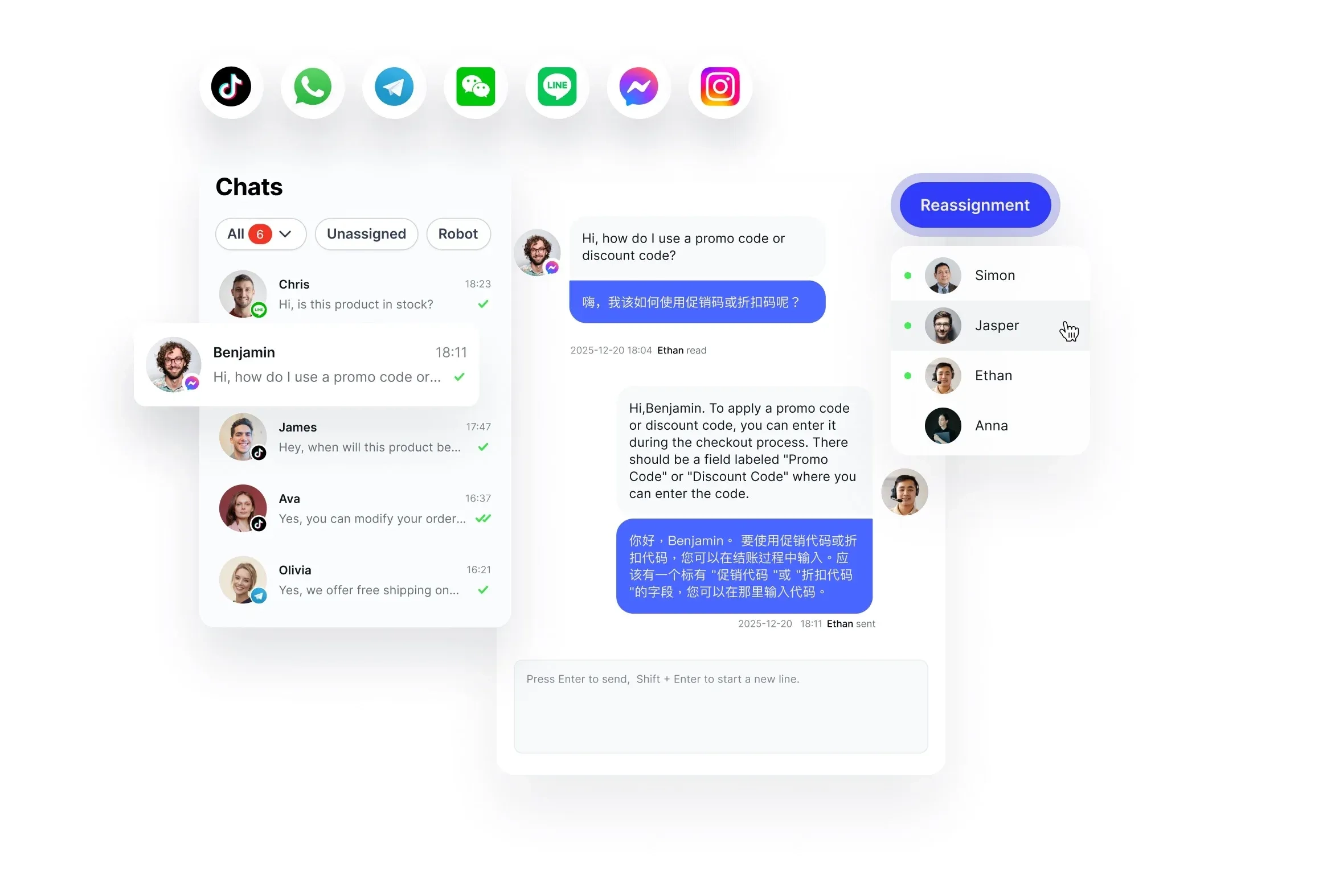
Beyond the sector, the channel matters just as much, because Indonesian customers reach businesses across many apps, so chatbots now run wherever people already message. This overview of Telegram bots in Indonesia shows how they extend into the everyday tools people use.
How Can a Business Maximize the Benefits of a Chatbot?
To get the most from a chatbot, keep its information up to date, set clear rules for what it should and should not handle, and give it a fast way to pass customers to a human. A chatbot only knows what you feed it, so these three habits decide whether it helps your customers or frustrates them.
The clearest warning sign came from the delivery company DPD in 2024.
A customer could not track his parcel and could not reach a human through the bot, so out of frustration he began testing it and coaxed it into swearing and writing a poem about how useless the company was. The screenshots went viral, and DPD switched the bot off, as CX Today reported. The takeaway is not that chatbots fail, but that this one had no clear limits and no clean way to pass the customer to a person.
To avoid that outcome, focus on two everyday habits that prevent most problems:
- Keep the information current: A chatbot answers from whatever data it holds, so when your prices, stock, or policies change without an update, it confidently gives the wrong answer. Connecting it to a live source keeps every reply accurate.
- Design a smooth handover: When a question grows too complex and the bot passes the chat to a person but loses the history, the customer has to explain everything again. A handover that carries the full conversation keeps the experience seamless.
Handled this way, a chatbot works as a reliable part of your team. Update its knowledge, define its boundaries, and pair it with a person for anything it cannot handle, and it stays an asset your customers trust.
How Does SaleSmartly Put These Functions to Work?
SaleSmartly runs all four chatbot functions across every channel your customers use and keeps each conversation in one shared inbox, so nothing gets lost between apps.
With SaleSmartly, we bring WhatsApp, Instagram, Facebook, and web chat into one place. The chatbot answers routine questions, qualifies leads, and passes complex cases to your team with the full history attached. Here is what that looks like in practice:
- Every function in one inbox: Customer service, sales replies, and follow-ups run from one shared workspace.
- Own-model AI: Connect GPTBots, Coze, Dify, OpenAI Assistants, ChatGPT, or DeepSeek so the bot matches your business.
- AI automation with human handover: Our chatbot answers instantly and escalates to an agent when a conversation needs a person.
- Real-time translation in 130-plus languages: Serve local and international customers with no language barrier.
Message our team on WhatsApp for a walkthrough built around your channels.
Conclusion
Every function of a chatbot serves one goal, which is to automate conversations so your business responds faster, sells smarter, and runs leaner. A single bot answers questions around the clock, guides buyers toward a purchase, handles heavy message volumes without extra staff, and reads your documents for accurate answers.
What turns those functions into daily results is the right setup. When you match the chatbot to where your customers message and what they ask most, it gives every customer an instant, consistent reply while freeing your team for the work that genuinely needs a person.
FAQs
What is the purpose of a chatbot?
The purpose of a chatbot is to automate conversations so a business responds instantly, at any hour, without a person handling every message. It answers questions, qualifies leads, and completes simple tasks on its own, freeing your team for complex work. The result is faster service for customers and lower operational cost for the business.
What is the difference between AI and a chatbot?
A chatbot is the tool that talks to users, while AI is the technology that can power it. A basic chatbot runs on fixed rules with no AI at all. An AI chatbot adds natural language processing, so it understands intent, handles unexpected questions, and improves over time. Every AI chatbot is a chatbot, but not every chatbot uses AI.
Is a chatbot the same as ChatGPT?
Not exactly. ChatGPT is one large language model built by OpenAI, while a chatbot is any program that holds a conversation with users. Many business chatbots connect to models like ChatGPT to generate answers, but the chatbot is the customer-facing tool with its own channels, workflows, and handover rules, not the model itself.
Omnichannel vs Multichannel: What Is the Difference?
A practical guide to the functions of a chatbot, the technology that powers it, and real examples of chatbots at work in business.
30+ Greeting Message Examples for WhatsApp Business and Online Stores
30+ greeting message examples for WhatsApp Business, online shops, and customer service, plus how to set them up and write ones that convert.
