What Is CRM Marketing? Guide, Examples & Strategy (2026)
Traditional CRM stores contact and track deals, while CRM marketing uses that same data to run personalized campaigns that lift retention, revenue, and ROI. This guide covers what CRM marketing means in 2026, how it works, six campaign types, how it differs from marketing automation, and a five-stage strategy for SMB marketing teams in Southeast Asia. For readers new to CRM as a whole, CRM overview is a good starting point.
Key Takeaways
- CRM marketing uses unified customer data to personalize campaigns, retain customers, and prove ROI across every channel.
- CRM marketing covers the full customer lifecycle, from first touch through retention and loyalty. Meanwhile, marketing automation focuses on executing campaign flows at high volume, firing triggered sequences based on engagement signals like opens and clicks. Most modern platforms combine both functions in one product.
- SMB marketing teams in Southeast Asia see the fastest results on WhatsApp, Instagram DM, and TikTok.
What Is CRM Marketing?
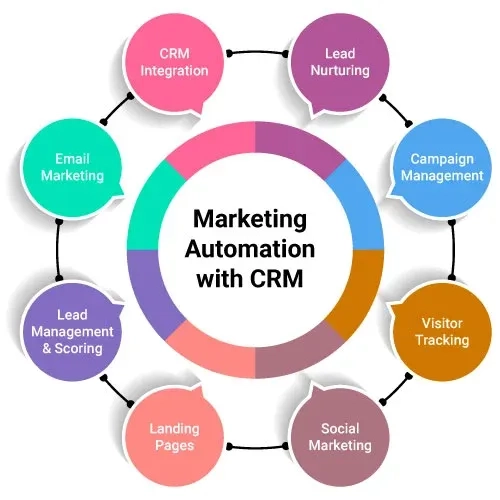
CRM marketing is a CRM system *that uses customer data to segment audiences, personalize campaigns, and tie marketing activity back to revenue and lifetime value.* The term covers two activities, including lifecycle marketing runs welcome flows, retention campaigns, and loyalty programs. Meanwhile, campaign personalization powers dynamic content and behavior-triggered messages that respond to individual customer actions.
For SMB marketing teams in Southeast Asia, CRM marketing usually starts when broadcast email stops working, open rates drop, and no one can prove which campaign drove sales.
How Does CRM Marketing Work?
CRM marketing pulls every customer signal into one profile, then uses that profile to trigger personalized campaigns on the channels the customer already uses. Modern platforms run on five layers:
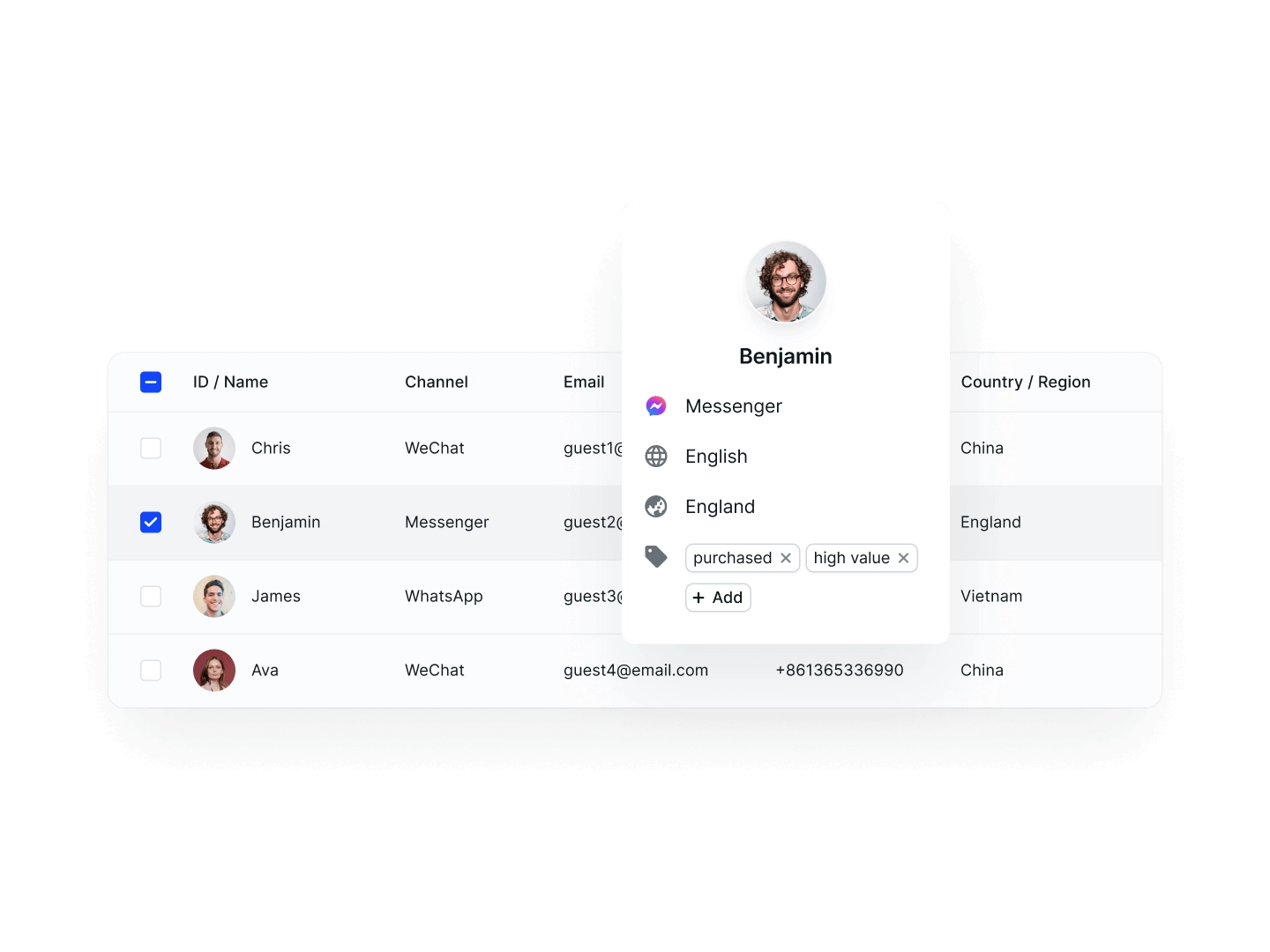
- Customer Data & Segmentation: The CRM captures signals from email opens, website visits, chat conversations, purchase history, and apps like Shopify or Tokopedia. Each record holds attributes like lifecycle stage, category interest, geography, and language. The system uses these to build dynamic segments that refresh as behavior changes.
- Content Personalization & Message Triggers: Marketers build campaign templates with dynamic fields (first name, last product viewed, cart items, loyalty tier) that the CRM fills in per customer. Triggers like cart abandonment, category browse, or 30 days of inactivity fire the right message to the right person without manual list pulling.
- Multi-Channel Delivery & Timing: The CRM sends the message through the channel the customer prefers. In Southeast Asia, that usually means WhatsApp, Instagram DM, and TikTok alongside email. Platforms like SaleSmartly work in this layer for chat-led marketing teams, sending campaigns through WhatsApp Business API and Instagram DM while building the customer record from actual chat conversations.
- Behavior Tracking & Engagement Signals: Every open, click, reply, page view, and purchase flows back into the customer record. This feedback loop keeps segments fresh and shows marketers which customers are warming up, cooling off, or ready to buy again.
- Attribution & Campaign Reporting: Dashboards tie campaign activity back to revenue, showing which segments drive the highest lifetime value, which channels convert best, and which campaigns need to be paused. Marketing leads use these reports to defend budget and shift spend.
How Some Actual Cases Marketing Team Use CRM Marketing
CRM marketing shows up in six recurring campaign types. Each one uses customer data to send the right message at the right moment:
- Welcome series after signup: New subscribers get a 3-5 email sequence over 7 days introducing the brand, product, and first-purchase incentive. Teams with chat channels add a WhatsApp welcome within 24 hours. This can lift first-purchase conversion by 15-25% since WhatsApp open rates reach 90%+ in Indonesia while email averages 20-30%.
- Abandoned cart recovery: A customer adds items to cart, then leaves. The CRM fires an email reminder at 4 hours and a second reminder with a discount at 24 hours, then stops once the customer buys or unsubscribes. For chat-led SMBs, WhatsApp cart recovery through SaleSmartly outperforms email since the reminder lands where the customer is already active.
- Birthday and loyalty milestone campaigns: The CRM fires a personalized birthday message with a reward code, plus milestone messages when a customer hits a purchase count or spend threshold. Volume stays low but conversion runs very high since both the moment and the reward are personal.
- Product recommendations from purchase history: A customer buys skincare cleanser, and the CRM fires a serum recommendation 14 days later. A phone case purchase fires a screen protector offer. Match the recommendation to what the customer actually bought or browsed, since generic "you might also like" lists fall flat when the CRM holds real customer data.
- Reactivation for dormant subscribers: Customers inactive for 60-90 days get a "we miss you" sequence with a targeted incentive. Some marketing teams use WhatsApp for reactivation since dormant customers usually stopped opening email long before going inactive.
- Cross-channel retargeting: The CRM syncs high-value segments to Meta Ads and Google Ads, so the same customer sees coordinated messaging across email, chat, and paid ads. This works when the CRM has clean segments and native ad integrations, which is where omnichannel CRM platforms shine.
CRM Marketing vs Marketing Automation
CRM marketing and marketing automation overlap enough that people use the terms interchangeably, but the two do different jobs. While CRM marketing works across the full customer lifecycle with data anchored to the customer record, marketing automation, on the other hand, runs campaigns at high volume, firing flows based on engagement signals like opens and clicks.
| Dimension | CRM Marketing | Marketing Automation |
|---|---|---|
| Primary data source | Unified customer profile | Campaign engagement (opens, clicks, form fills) |
| Core job | Build long-term customer value through personalization and retention | Execute campaign flows at high volume |
| Time horizon | Full customer lifecycle | Single campaign or funnel window |
| Typical tools | HubSpot CRM, Zoho, Attio, SaleSmartly | Mailchimp, ActiveCampaign, Marketo |
| Success metric | Customer lifetime value, retention rate, segment revenue | Open rate, click rate, funnel conversion |
CRM marketing builds customer relationships over time, while marketing automation runs campaigns at high volume. Retention, cross-sell, loyalty, and personalization all depend on knowing the customer, so they fall under CRM marketing.
Meanwhile, product launches, event promotions, and lead nurture depend on scale, so they fall under marketing automation. Most modern platforms handle both jobs. HubSpot, ActiveCampaign, and SaleSmartly all offer CRM data alongside automation workflows, so most SMBs today pick a platform that leads with one side and covers the other.
Do Marketing Teams Actually Need a CRM?
Yes, for marketing teams handling retention, personalization, or multi-channel campaigns. CRM stops being optional once the team moves past basic newsletter broadcasts. Very small teams sending occasional blasts to one static list can survive on Mailchimp alone.
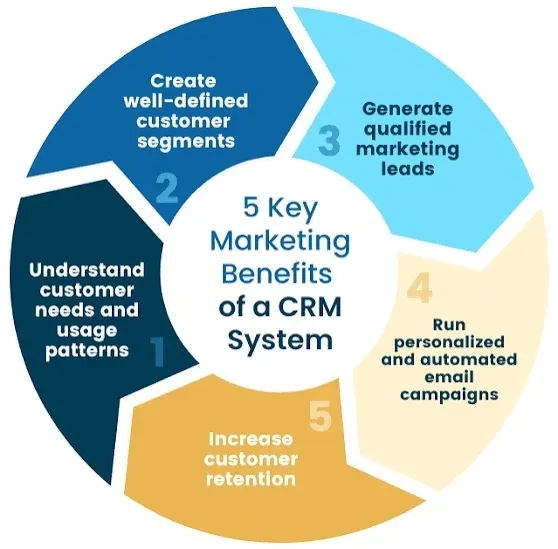
Here are some proven benefits when marketing teams implement CRM include:
- Segments that update themselves: Customer lists reflect current behavior automatically, so campaigns always target the right people.
- Personalized messages per segment: Dynamic content adapts per segment without a marketer copying variants by hand.
- Retention campaigns triggered by behavior: Dormant, at-risk, and loyal cohorts get flagged automatically, so retention campaigns run themselves.
- Real attribution across channels: Marketing leads prove which campaign, segment, and channel drove revenue.
- Marketing hands qualified leads to sales: Leads reach sales with full engagement history, so the first sales conversation starts with context.
CRM marketing pays off only when teams actively use the data. Many actual teams on Reddit reported that without clear ownership, businesses invest in costly CRM systems but continue running campaigns through legacy tools, adding expense without improving ROI.
How to Build a CRM Marketing Strategy?
A CRM marketing strategy runs on five stages, including the current setup, defines clear goals and KPIs, chooses the right tools, maps segments and workflows, then monitors results and iterates.
Assess Your Current Marketing Data and Channels
Before choosing any tool, the team needs to know its customer data, since skipping this audit is why most CRM projects fail. Teams on r/CRM often describe the same mistake, where they buy an enterprise CRM before checking whether current data is clean, then pay a premium for a tool that runs on dirty data.
- Audit customer data sources: List every place data currently lives, such as email platform, chat inbox, purchase database, ad platforms, website analytics, and offline events.
- Map the current marketing stack: Document what each tool does today and where handoffs break. Duplicate contacts across Mailchimp and a chat inbox usually reveal the biggest issues.
- Identify missing segments: Note which customer segments the team can define today (usually just "all subscribers") versus the segments the team actually needs.
- Assess team skills honestly: A CRM built for a marketing ops specialist falls flat when the team is a solo marketer wearing five hats. The stack has to match the people.
Define Clear Marketing Goals and KPIs
Every KPI shapes what the team builds. A retention KPI directs the team toward reactivation and loyalty, a list growth KPI toward lead magnets and paid acquisition, and a revenue-per-subscriber KPI toward personalization and upsell. The clearer the KPI, the sharper the roadmap.
- Set 3-5 top-level marketing KPIs: Common choices are customer lifetime value, retention rate, list growth rate, revenue attribution by channel, and average order value.
- Ladder KPIs to business metrics: Every KPI should connect to revenue, cost, or customer growth. If leadership doesn't care about it, it gets deprioritized in the first budget review.
- Set targets with timeframes: "Lift 90-day retention by 8% by end of Q2" gives the team a number to hit and a deadline. Campaign design then focuses on moving that number.
- Define what failure looks like: Every KPI needs a floor. If retention drops below the floor, the strategy needs a review, and the team should know that in advance.
Choose CRM Marketing Tools That Match the Team
The right CRM marketing tool depends on team size, channel mix, budget, and where the audience actually spends time. Marketing leads who match tools to real constraints avoid buying enterprise CRMs the team never uses.
- Match tool depth to team size: Solo marketers do well with lightweight tools like Attio or HubSpot Free. Teams of 3-10 marketers can support HubSpot Marketing Hub Starter, Zoho CRM Plus, or ActiveCampaign. Enterprise CRMs like Salesforce Marketing Cloud usually need a dedicated marketing ops role to justify the cost.
- Match channels to audience behavior: For B2C SMBs in Southeast Asia where audiences live on WhatsApp and Instagram, chat-first platforms like SaleSmartly fit the team's daily workflow. The CRM record is built directly from the conversations the audience is already having. For B2B SMBs where audiences live in email and LinkedIn, traditional CRMs like HubSpot or Zoho are the safer choice.
- Test integration with existing tools: The CRM has to connect with the software CRM stack the team already uses, including email platforms, ad managers, ecommerce systems (Shopee, Tokopedia, Shopify, Lazada), and analytics tools.
- Model the full cost of ownership: Subscription is only one line item. SSO tiers alone can double the price for teams that need enterprise security compliance. Implementation runs $2,000-15,000 for mid-tier CRMs. Staff training runs another 20-40 hours per marketer. Data migration from spreadsheets can take 4-8 weeks with a consultant. Marketing teams on r/CRM regularly flag these hidden costs as the reason mid-year budget surprises kill CRM adoption.
Map Segments and Automated Workflows
Segmentation is where CRM marketing delivers real value. Marketing teams that define 5 useful segments and build automated workflows around them ship campaigns quickly, while teams that try to build 50 hyper-specific segments from day one often get stuck in design and never launch.
- Start with 5 base segments: New subscribers, first-time buyers, repeat buyers, dormant customers (60-90 days inactive), and high-value/VIP customers. These 5 cover most SMB marketing use cases.
- Layer behavior-based triggers on top: Cart abandonment, product page browse, category interest, and content downloads add reactive segments to the base 5 without inflating segment count.
- Design 3-5 high-impact automated flows: Welcome series, abandoned cart, post-purchase onboarding, dormant reactivation, and loyalty milestone. Every flow needs a trigger, message sequence, exit condition, and success metric.
- Coordinate frequency across channels: A cap of 3-5 marketing touches per customer per week across email, chat, and ads prevents fatigue and unsubscribes. For chat channels, treat WhatsApp Business API 24-hour session rules as the frequency cap.
Monitor Results and Iterate on Underperforming Campaigns
CRM marketing improves when the team measures every campaign and iterates. Teams that build a monthly reporting rhythm and treat each campaign as a test outperform teams that launch and forget.
- Set a revenue attribution model before running campaigns: First-touch, last-touch, or multi-touch attribution each tell a different story. Multi-touch is usually the honest choice for SMBs with decision cycles that stretch beyond a week.
- Report monthly on a small set of KPIs: Customer lifetime value by segment, revenue by campaign type, and retention rate month-over-month. Those three are what marketing leads need to defend budget. Everything else is diagnostic.
- Run one A/B test per campaign: Subject line, send time, or offer, tested one variable at a time. Statistical significance requires enough volume, so batch small campaigns together to reach it.
- Apply what you learn back into segmentation: Every campaign result should refine segment definitions and the customer journey map. CRM marketing improves through this loop.
FAQs
What are some examples of CRM marketing?
Common examples include welcome email series after signup, abandoned cart recovery via WhatsApp or email, birthday and loyalty milestone campaigns, product recommendations from purchase history, dormant customer reactivation, and cross-channel retargeting through Meta and Google Ads synced from CRM segments. Each one uses customer data to trigger the right message at the right moment.
What is a CRM example?
Popular CRM platforms marketing teams use include HubSpot CRM (best for teams that want free-tier entry with a growth path), Zoho CRM (best for teams that want a bundled software suite), Salesforce Marketing Cloud (enterprise), and SaleSmartly (best for chat-led marketing teams in Southeast Asia whose audiences live on WhatsApp, Instagram DM, and TikTok).
Is CRM marketing easy to learn?
Yes for entry-level platforms like HubSpot Free, Mailchimp with CRM add-ons, and SaleSmartly. These are built for non-technical marketers to set up and use within a day. Enterprise platforms like Salesforce Marketing Cloud have a steeper learning curve and often need a dedicated marketing ops specialist to configure and maintain.
Can a marketing team do CRM marketing without a dedicated CRM tool?
No. A team can run basic segmentation and personalized email through Mailchimp for a small audience. Once the team wants behavior-triggered flows, multi-channel campaigns, or cross-channel attribution, a proper CRM becomes essential. The exception is a very small team with a static list and a single channel, which can survive on email alone until growth demands more.
What Is Omnichannel CRM? A Complete Explanation for 2026
Discover what omnichannel CRM is, how it works, and how to choose the right platform to unify your customer conversations across every channel.
Omnichannel vs Multichannel: What Is the Difference?
A practical guide to the functions of a chatbot, the technology that powers it, and real examples of chatbots at work in business.
