What Can AI Actually Do in Customer Service?
In an era where customers expect instant responses 24/7 across every platform, the traditional customer service model starts to show its weaknesses: it is slow, labor-intensive, and hard to scale as the business grows.
AI is not here to replace people. Instead, it becomes an operational layer that helps customer service teams work faster, smarter, and more consistently. So what can AI actually help with in the customer service process? Let's walk through it with SaleSmartly in this article.
What Can AI Help With in the Customer Service Process?
AI Replies to Customers Automatically, 24/7
Most customer questions really do revolve around the same handful of scenarios:
- Asking about pricing
- Asking about delivery estimates
- Asking about the return policy
- Confirming an order
AI can handle these questions automatically without a support agent needing to be online, even at 2 a.m. or on a public holiday.
This does more than spare customers a long wait. It also frees the support team from repetitive questions so they can focus on the cases that need empathy, judgment, and human interaction.
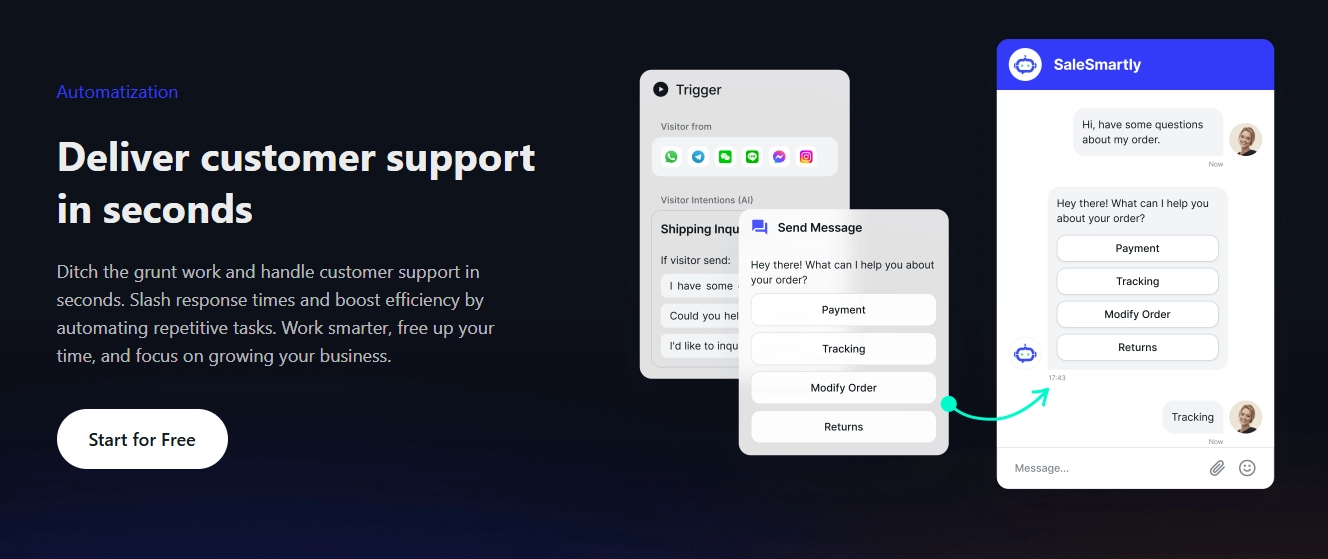
AI Classifies and Prioritizes Conversations Intelligently
Not every customer message carries the same urgency. AI can recognize and prioritize conversations such as:
- An angry customer → needs immediate handling
- A customer with high purchase intent → should be routed to sales straight away
- A customer who goes quiet after a problem → at risk of churn and needs proactive follow-up
- A general question → can join the normal queue
Instead of a first-come, first-served system, AI helps the support team focus on the conversations that matter most first.
That makes a real difference in reducing the risk of losing potential customers when chat volume spikes.
AI Helps Agents Respond Faster and More Accurately
AI is not only about automation. It can also act as a smart assistant for the support team.
AI can help agents by:
- Drafting suggested replies
- Translating conversations in real time
- Summarizing long chat histories
- Recommending relevant responses
- Surfacing customer information quickly
The result is faster response times while service quality stays consistent.
For businesses serving international customers, AI translation is particularly useful because it lowers the language barrier without hiring a large multilingual team.
AI Personalizes the Customer Experience Based on Conversation History
Personalization has become an important factor in improving customer experience and loyalty.
AI can analyze:
- Purchase history
- Customer behavior
- Conversation context
- Previous interactions
Working from that data, AI can give more relevant responses than a single template applied to every customer.
For example, a customer who previously bought Product A can automatically receive a relevant recommendation for Product B.
That creates a customer experience that feels more personal and more relevant.
AI Handles Repetitive Tasks So the Team Can Focus on Complex Cases
AI chatbots are highly effective for repetitive tasks with a fixed flow, such as:
- Answering FAQs
- Replying to chats outside business hours
- Classifying conversations
- Sending automated notifications
- Routing workflows
Tasks like these usually consume a lot of operational time but do not always require human decision-making.
With AI in place, the support team can focus more on:
- Handling complaints
- Complex product consultations
- VIP customer service
- High-value sales opportunities
Applied properly, AI reduces the repetitive workload so the team can concentrate on improving customer experience and business revenue.
Common Mistakes When Implementing an AI Chatbot in Customer Service
Automating Too Much of the Customer Interaction
Not every customer service situation is suited to automation.
Chatbots work very well for predictable questions such as FAQs, order confirmations, or standard information. But when a customer is upset about an order problem or needs a consultation before buying a complex product, a chatbot cannot replace human flexibility and empathy.
The core problem is not the chatbot. It is a business that never defines a clear boundary between what can be automated and what needs a human agent.
If that boundary is not designed well, the customer experience feels inconsistent and eventually damages trust in the brand.
The simple principle:
- Standard questions → AI
- Situations that need judgment and empathy → humans
Not Having Centralized Conversation Data
AI does not become smart on its own. It learns from customer conversation data.
If customer data is scattered across WhatsApp, Facebook, Instagram, email, and other systems with no clear structure, then even the most sophisticated chatbot will only ever operate at a basic level.
This is a fairly common infrastructure mistake: the business invests in AI before building a centralized customer communication system.
The consequences:
- AI does not improve over time
- Customer question patterns are hard to analyze
- Operational insight stays limited
- The customer experience becomes fragmented
An omnichannel system that brings every customer conversation into one place is the foundation to lay before applying advanced AI.
Ignoring Escalation to a Human Agent
This is one of the most common and most costly failures in a chatbot rollout.
The scenario plays out often:
- A customer asks something beyond the bot's ability
- The bot cannot resolve the problem
- The conversation is never passed to a human agent
- The customer keeps receiving the same automated answer
This does not just frustrate customers. It erodes trust the brand had already built.
A well-built AI customer service system needs three layers:
- Detection layer: the bot knows when it has reached the limit of what it can handle
- Escalation layer: the conversation is routed automatically to the right agent, along with the full conversation context
- Continuity layer: the human agent can pick up the conversation without asking the customer to start over
That is the main difference between a properly designed AI customer service system and an ordinary chatbot.
How Does SaleSmartly Use AI in Customer Service?
For many businesses, AI is treated as an add-on feature. In practice, AI only becomes genuinely effective when it is combined with a centralized conversation and customer data management system. That is the approach SaleSmartly takes to AI-based customer service operations.
Beyond the AI chatbot, SaleSmartly also provides features that help businesses manage customer service more systematically, such as:
- Centralized storage of every customer conversation history
- Tagging and classification of potential customers
- Response performance monitoring for each agent
- Customer service workflow automation
- Omnichannel customer data synchronization
Rather than stitching together several separate tools, a business can run the entire customer service process inside one platform.
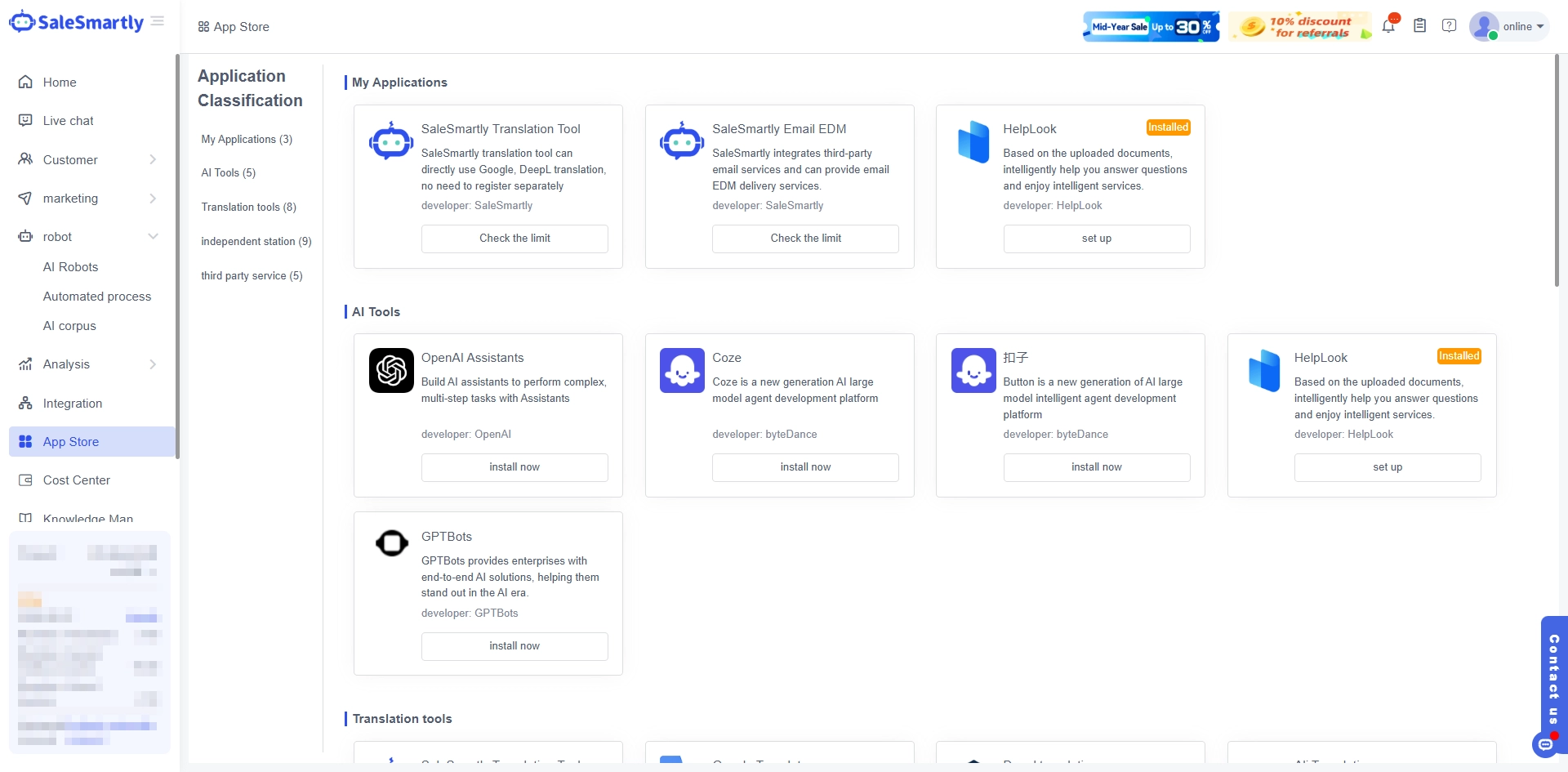
This is why SaleSmartly is widely used by omnichannel and cross-border businesses to handle thousands of customer conversations every day without continually adding support headcount.
More than 10,000 businesses already use SaleSmartly to handle thousands of conversations a day — faster, more efficiently, and without leaving customers waiting.
👉 Try SaleSmartly free at salesmartly.com and see the AI customer service features for yourself, no credit card required.
Email Marketing End to End: Content, Segmentation, and Reply Management in One Place
SaleSmartly consolidates four email marketing steps into one system: content creation, customer segmentation, variable personalization, and reply management.
WhatsApp Username & BSUID: What Indonesian Business Owners Need to Know Right Now
WhatsApp usernames are coming in 2026. Here's what changes for Indonesian businesses — and why BSUID matters more than the username itself.
