What Is an AI Chatbot for Customer Service and How Does It Work?
Key Takeaways
- AI chatbot customer service uses natural language understanding, large language models, and retrieval-augmented generation to answer customer questions in real time, draft replies for agents, and pass complex cases to human teams with the full customer profile attached.
- AI chatbot customer service delivers real wins when scoped narrowly. Teams that pair AI chatbots with a clean knowledge base and a human review step cut repetitive workload without losing service quality, while teams that expect full deflection or deploy against messy documentation almost always regret it.
- Research from Harvard Business School shows AI chatbots help human agents respond about 20% faster with more empathy and thoroughness, while ISG data shows AI cuts support costs by around 30% and lifts customer satisfaction by 80% in strong deployments.
This guide explains what an AI chatbot for customer service is, how it works, where it delivers real gains, and where it falls short. It also walks through the four practical steps for choosing a platform that fits your team's actual workflow.
What Is an AI Chatbot Customer Service?
An AI chatbot for customer service is a software agent that uses natural language processing and machine learning to hold two-way conversations with customers, answering questions, resolving common issues, and passing complex cases to human agents.* It understands the intent behind how customers actually phrase things, so it works even when the wording changes from one message to the next.
How Is It Different From a Traditional Chatbot?
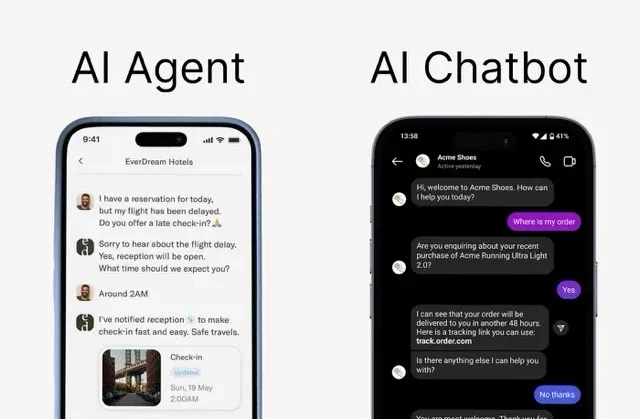
A traditional chatbot matches keywords to preset answers written in advance, while an AI chatbot understands intent, generates fluent replies with a large language model, and pulls answers from your live knowledge base through retrieval-augmented generation. The table below compares them across the traits that matter for a customer service team.
| Traditional Chatbot | AI Chatbot | |
|---|---|---|
| How it responds | Matches keywords to preset scripted answers | Understands intent using NLU, generates fluent replies with an LLM |
| Grounding | Hard-coded answers written in advance | Pulls answers from your live knowledge base through RAG |
| Phrasing flexibility | Breaks when the customer phrases something new | Recognizes the same intent across many wordings |
| Setup effort | Manual scripting of every branch | Connect knowledge base, tune prompts, iterate |
| Failure mode | Dead-end conversations, "I did not understand" replies | Fluent but wrong answers if the knowledge base is poor |
The two chatbots differ in three ways that matter every day for the customer service team.
- Understanding of natural language: The basic chatbot works only when the customer phrases things the way the script writer expected. The AI chatbot handles the same question phrased ten different ways.
- Source of answers: The basic chatbot repeats what was hardcoded. The AI chatbot retrieves answers from your product docs and FAQs in real time, so updates to the knowledge base flow automatically.
- Failure mode you get: With a basic chatbot the risk is dead-end conversations. With an AI chatbot, the risk shifts to confident but wrong answers when the knowledge base is messy, which is why documentation quality matters more than any other input.
How Does an AI Chatbot Customer Service Work?
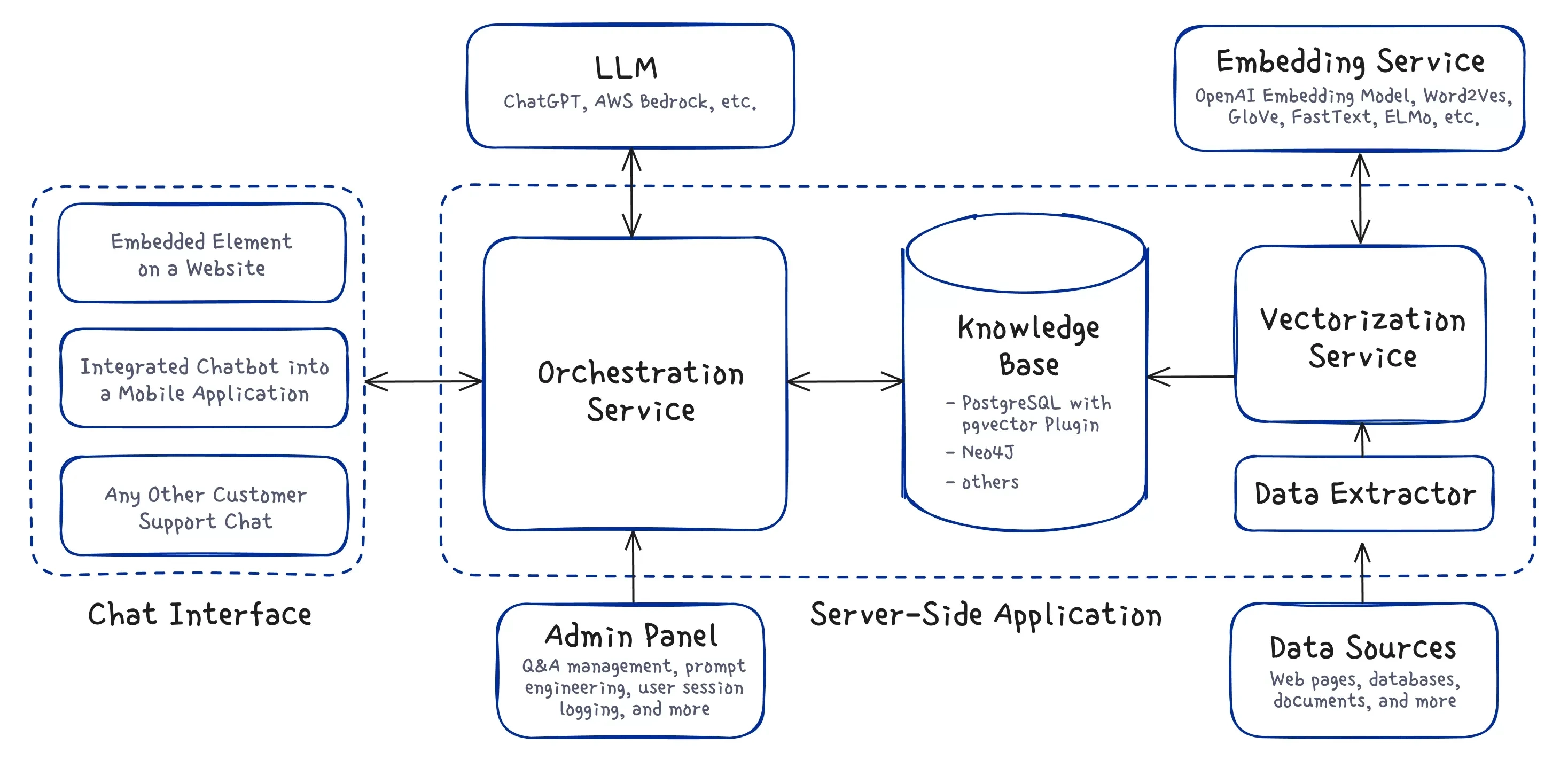
An AI chatbot for customer service works through five connected layers that ingest your knowledge base, understand each incoming message, generate a response, hand over to a human agent when needed, and improve from every review. Each layer earns its place in the modern architecture used by enterprise-grade deployments today.
- Knowledge Ingestion & Grounding
The AI chatbot connects to your product docs, FAQs, help center articles, and past ticket resolutions, then indexes them into a searchable database so the language model can retrieve the right passage when answering a question. This grounding is what prevents AI from inventing answers that sound right but are wrong.
- Intent & Entity Recognition
When a message arrives, the NLU layer parses what the customer wants (intent) and pulls out the specific values that matter (entities such as order number, product name, or account ID), so the chatbot responds to the actual question and not just the surface keywords.
- Response Generation & Safety Rules
The LLM composes a response using the retrieved knowledge, filtered through safety rules that block off-topic content, restrict sensitive claims, and force citations back to source documentation where policy requires it.
- Handover To A Human Agent With Context
When the chatbot recognizes a query outside its confidence range, it moves the conversation to a human agent along with a short summary of what was tried and what still needs answering, so the agent picks up mid-conversation without asking the customer to repeat.
- Feedback Loop & Continuous Improvement
Every reviewed conversation feeds back into the system, letting teams tune responses over weeks and months as edge cases surface and the knowledge base expands.
For a technical breakdown of the RAG architecture that powers this workflow, IBM's overview of AI customer service chatbots covers the enterprise implementation guidance in detail.
Common AI Chatbots in Customer Service Use Cases
AI chatbots handle the repetitive layer of customer service work, freeing human teams for the complex issues that need judgment. In deployments from banks to online retailers, five use cases show up over and over.
- Answer incoming messages first and route the rest: The chatbot fields every incoming message, resolves simple questions instantly, and passes anything complex to the right agent or team, so no query sits waiting for triage.
- Resolve repetitive FAQs automatically: Password resets, order status checks, return policies, and shipping questions get answered without a human touch, cutting the volume of tickets that ever reach an agent.
- Cover customers around the clock across time zones: Buyers in different regions get accurate answers at any hour without overnight staffing, which matters in Southeast Asia where WhatsApp messages arrive at all hours through Telegram bots, WhatsApp, and Instagram DM.
- Guide banking customers through account queries: Bank of America's Erica assistant passed 10 million users, handling account queries, transaction lookups, and financial guidance without pushing each request to a call center.
- Help retail shoppers pick the right product: Lego's Ralph chatbot supported holiday shopping by matching customers to the right gift based on age, price, and interest, a use case that would have needed dozens of live agents at peak season.
Types of Customer Service AI Chatbots
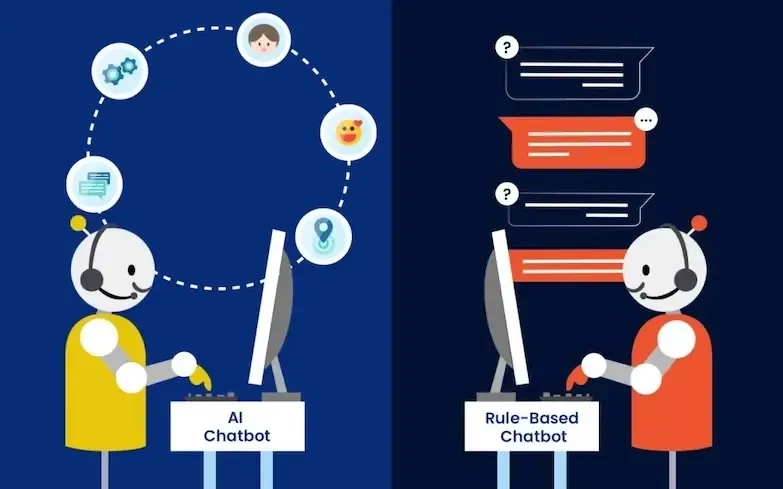
AI chatbots for customer service fall into three main categories based on how they generate responses, including rule-based bots that follow scripts, conversational AI bots use NLU to understand intent, and agentic AI bots combine LLMs with tools to take actions across systems. The right choice depends on how complex your customer service workflows actually are.
| Type | How It Responds | Best For | Trade-Off |
|---|---|---|---|
| Rule-based | Follows scripted flowcharts and keyword triggers | Simple FAQs with predictable phrasing | Breaks when customers phrase things unexpectedly |
| Conversational AI (NLU/NLP) | Recognizes intent and generates fluent replies grounded in a knowledge base | Mid-complexity queries where context matters | Needs a clean knowledge base and periodic tuning |
| Agentic AI (LLM + tools) | Understands intent, retrieves knowledge, and executes actions such as order updates or refunds | Complex workflows that touch multiple systems | Higher setup cost, more governance overhead |
The three types differ in ways that matter every day for the customer service team.
- Handling of phrasing variation: Rule-based bots break on new phrasings, while conversational AI and agentic AI both understand the intent behind different wordings.
- Ability to take action: Only agentic AI can execute real actions inside your systems. The other two answer questions but cannot update an order or process a refund on their own.
- Setup effort: Rule-based deployments finish fastest, conversational AI needs a knowledge base ready, agentic AI needs both the knowledge base and safe tool integrations.
- Failure mode: Rule-based bots frustrate users with dead-ends, conversational AI risks fluent but wrong answers if the docs are poor, agentic AI risks executing wrong actions if the safety rules are weak.
For a broader view beyond chat-only interfaces, our guide on AI bots for customer service covers voice agents and workflow automation alongside chatbots.
Is an AI Chatbot for Customer Service Actually Worth It?
Yes, for the right use case. Teams handling high volumes of repetitive queries against a clean knowledge base with humans reviewing anything ambiguous see measurable gains, while teams expecting full deflection or deploying against messy docs almost always regret it.
A Harvard Business School study of over 250,000 chat conversations found AI helped human agents respond about 20% faster with more empathy and thoroughness, while ISG research shows AI cuts support costs by around 30% and lifts customer satisfaction by 80% in strong deployments.
AI Chatbot Mistakes to Avoid in Customer Service
AI chatbots for customer service fail in four predictable ways, and each has a specific fix worth locking in before deployment.
- Keyword matching without real understanding: Pre-LLM chatbots relied on keyword triggers that broke the moment a customer phrased something differently. Fix this by deploying a conversational AI or agentic AI platform that uses NLU and RAG to understand intent, not just spot words.
- Messy or contradictory knowledge base: As one practitioner puts it plainly on a Reddit thread, if the docs are messy, the AI just repeats the confusion faster. Fix this by auditing and cleaning the knowledge base before deployment. Remove contradictions, retire outdated articles, and confirm each FAQ answers the customer's actual question, not the internal team's version of it.
- Unrealistic deflection targets: Teams expecting 70 to 90% ticket deflection almost always fail. Fix this by starting narrow, with the five to ten highest-volume repetitive queries, and expanding only as the AI proves accurate on each new query type.
- Broken handover to human agents: When the AI escalates with a long raw transcript, the human agent loses time reading it and the customer often gets asked to repeat. Fix this by requiring the AI to pass a short summary of what the customer asked, what was tried, and what still needs answering. Platforms designed around this from the start, such as SaleSmartly, pass the conversation alongside the full customer profile from the same omnichannel inbox, so the human agent sees the context in one screen without reconstructing it from scrolled logs.
How to Choose the Right AI Chatbot for Your Customer Service Team
Match The Chatbot Type To Your Use Case Complexity
Start by mapping your top ten customer service query types by frequency and complexity, then match the chatbot type to what you see.
- FAQ-heavy volume: If most queries sit in the FAQ range such as order status, business hours, or return policy, a conversational AI chatbot grounded in your knowledge base handles the load.
- Actions across systems: If a meaningful share of queries requires actions such as rescheduling appointments, updating account settings, or processing refunds, agentic AI earns its higher cost.
- Mixed workload: If you sit between the two, start with conversational AI and add agentic capabilities once the automation of simple queries proves stable.
For broader business chatbot use cases beyond customer service, our guide on AI chatbots for business covers wider applications.
Verify The Knowledge Base And RAG Architecture
Ask the vendor three specific questions during the demo. For example, how does the chatbot ingest your knowledge base, through direct API connections to your help center and CRM, or through manual uploads that go stale?
Then continue discovering whether the platform uses retrieval-augmented generation to ground answers in your actual documentation or the LLM answers from general training data with all the hallucination risk that carries?
Lastly, can the chatbot cite the source article it pulled the answer from, so your team can audit accuracy without reading every conversation?
Test How Well The Chatbot Hands Over To Human Agents
Most AI chatbot deployments fall apart at the moment the conversation moves to a human, so pressure-test this specifically during the demo with three real scenarios.
- A question the chatbot cannot fully answer: Ask something just outside the AI's confidence range and check whether it escalates cleanly or forces the customer to repeat the whole question.
- A frustrated or upset customer message: Send an emotionally charged message and check whether the AI recognizes the tone shift and passes to a human without further probing.
- A back-and-forth conversation over 3 to 4 exchanges: Ask a question that requires several turns, then check whether the human agent receives a short structured summary or a raw transcript they have to scroll through.
Platforms like SaleSmartly embed the AI agent inside the same omnichannel inbox the human team uses, so the handover carries the full customer profile and conversation timeline by default without an extra sync between separate tools.
Model The Full Cost Of Ownership
Vendor sticker prices cover only one line of the actual year-one cost. Four extra cost centers matter before you sign.
- Per-conversation LLM token fees: Most AI chatbot platforms charge separately for LLM inference or bundle it inside a message-credit system that scales with volume.
- WhatsApp Business API messaging fees: Meta bills per message in Indonesia, with marketing messages around Rp586 and utility or authentication messages around Rp357 each, plus 11% VAT.
- Human review time: In workflows where the AI writes and a human reviews before sending, agents still spend time on every response. Budget an hour per agent per day for review at high volumes.
- Setup and knowledge base preparation: Cleaning and structuring the source documentation is often the longest and most expensive phase, typically 2 to 6 weeks for a mid-size team.
How SaleSmartly Supports AI-Powered Customer Service
Most AI chatbot tools ship as standalone products, leaving teams to manually connect AI conversations to their CRM records and agent workspaces after the fact. SaleSmartly is the unified AI agent, the human agent workspace, and the customer record that brings the same omnichannel inbox, which fits the way chat-led businesses in Indonesia and Southeast Asia actually operate. Our platform delivers:
- AI agent embedded inside the unified inbox: Every AI response ties to the customer's profile from WhatsApp, Instagram, TikTok, Facebook Messenger, and other channels, without an extra integration layer.
- RAG-grounded answers from your own knowledge base: The AI agent retrieves from your product docs and FAQs to answer accurately, not from general LLM training data.
- Clean handover with the full customer profile: When the AI passes a conversation to a human, the agent sees the structured summary plus every past interaction in one screen.
SaleSmartly is built for chat-first customer service. We do not replace a dedicated voice-only support platform or the core operations systems used in banking and insurance. For teams whose customers already live on WhatsApp and messaging apps, the platform handles the full AI-and-human workflow in one place.
Integrate a smart AI chatbot into your customer service workflow with SaleSmartly today!
FAQs
Can you give me examples of customer service chatbots?
Yes. Well-known deployments include Bank of America's Erica, which passed 10 million users as a virtual financial assistant, and Lego's Ralph, which helped customers pick holiday gifts by age, price, and interest. Beyond named consumer brands, most modern deployments run inside meal delivery, e-commerce, and SaaS teams as internal chatbots that draft replies for human review before sending.
Can AI do customer service calls?
Yes, through a different technology stack. AI chatbots handle text-based conversations across chat, WhatsApp, email, and messaging apps. AI voice agents handle phone calls using speech-to-text, LLM reasoning, and text-to-speech synthesis. Some platforms offer both under one contract, while others specialize. The right choice depends on where your customers actually reach out.
30+ Greeting Message Examples for WhatsApp Business and Online Stores
30+ greeting message examples for WhatsApp Business, online shops, and customer service, plus how to set them up and write ones that convert.
Chatbot vs Web Tracking: What Are the Similarities and Differences?
A clear guide to the similarities and differences between chatbot and web tracking, how each collects data, and how businesses use them together.
