What Is an AI Chatbot? How It Works, What It Does, and the Best Tools in 2026
Every business that messages customers eventually faces the same problem: conversation volume grows faster than the team can handle. Questions repeat, response times slip, and customers leave before anyone replies. An AI chatbot automates those routine conversations, freeing agents for the work that needs human judgment.
This guide explains what an AI chatbot is, how it works, where it helps, its limits, and the leading tools in 2026.
What Is an AI Chatbot?
An AI chatbot is software that holds natural, human-like conversations with customers using artificial intelligence, rather than a fixed script.
Traditional bots could only respond with pre-written answers. An AI chatbot understands the meaning behind a customer's message and generates a relevant reply on its own, even for questions it was never explicitly programmed to handle.
As Google Cloud explains, the key difference is that AI chatbots run on large language models, the same technology behind tools like ChatGPT, instead of pre-set conversation flows.
What Can an AI Chatbot Do?
With an AI chatbot, a business can automate conversations that once required an agent's full attention, and do it well enough that customers often cannot tell the difference.
Its core capabilities include:
- Intent recognition: Understands what a customer actually wants, even with typos, slang, or mixed languages. This is the single biggest advance over rule-based bots, which break the moment a customer phrases something unexpectedly.
- Generative responses: Produces context-aware answers on the spot instead of pulling from a fixed reply library, so it can handle questions no one anticipated.
- Knowledge retrieval: Draws answers directly from your help articles, documentation, and product data, which keeps replies accurate and specific to your business rather than generic.
- Conversation memory: Follows the full thread and remembers earlier details, so a customer who mentioned an order number does not have to repeat it three messages later.
- Human handover: Escalates complex or sensitive cases to a live agent with the entire conversation attached, so the customer never starts over.
- Omnichannel operation: Runs across website chat, messaging apps, and voice from a single system, giving customers the same experience wherever they reach out.
How Does an AI Chatbot Work?
An AI chatbot converts your business information into knowledge a customer can access through conversation.
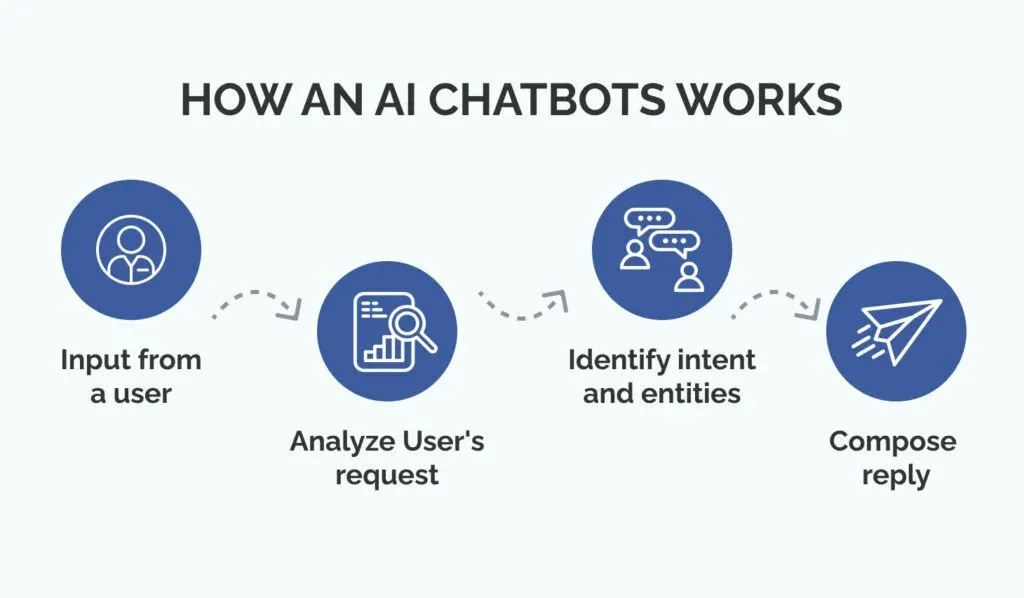
Behind the scenes, it works in four steps:
- Interprets the message to determine what the customer is asking for.
- Retrieves the relevant information, from the model's knowledge or your connected help content.
- Generates a natural reply suited to the context of the conversation.
- Escalates to a human agent when the request exceeds its scope, passing along the full history.
Performance depends heavily on the content behind it. In practice, an AI chatbot makes data such as websites, documents, and product catalogs accessible through everyday conversation.
A chatbot connected to accurate, current help content responds reliably, while one left to guess does not, which is why setup and knowledge quality matter more than the underlying model.
Where Do Businesses Use AI Chatbots?
Customer service is the first area where AI chatbots deliver returns, because so much support volume is repetitive, and repetitive work is exactly what automation handles best. Industry data shows AI chatbots can resolve up to 80% of routine questions, which frees agents to focus on the complex cases that genuinely need them.
Common applications include:
- Instant responses to product, pricing, stock, shipping, and return queries, delivered in seconds at any hour. These questions make up the bulk of most support queues, so automating them removes the largest source of backlog.
- Order and account lookups pulled through integration with your systems, letting customers check status, tracking, and account details without waiting for an agent.
- Lead qualification that reads intent to identify high-value conversations and routes them straight to sales, turning support chats into a revenue channel.
- After-hours coverage that answers overnight and weekend messages at full speed, so inquiries no longer pile up until the next business day.
Beyond service, businesses increasingly use AI chatbots for proactive sales, such as recovering abandoned carts and recommending products, and for internal support, answering common staff questions about IT or HR. The pattern is consistent: once a team automates one use case successfully, it usually expands the chatbot into others.
Check our
best AI WhatsApp chatbots in Indonesia
.
Does an AI Chatbot Actually Work?
Yes. With strategic integration, AI chatbots deliver measurable results.
Companies report up to a 30% reduction in customer support operational costs and a 50% drop in cost per call, according to Gartner. However, performance still depends on the quality of the data behind the chatbot: how you set it up, your message, your workflow.
What Are the Top 5 AI Chatbots in 2026?
SaleSmartly, Intercom (Fin), Tidio (Lyro), Zendesk AI, and ManyChat are the top 5 AI chatbots for business use in 2026, each suited to a different setup.
SaleSmartly — Best for Omnichannel AI Across Every Channel
SaleSmartly runs a single AI chatbot across every channel a business uses, unified in one shared inbox. It combines automation with team collaboration, CRM, and analytics, and lets you connect your preferred AI model rather than locking you into one. Trusted by 300,000+ businesses across 100+ countries, it suits teams managing customer conversations across many channels at once.
- AI model choice: One-click integration with GPTBots, Coze, Dify, OpenAI Assistants, ChatGPT, and DeepSeek.
- Intent recognition with fallback: Replies automatically and sends a fallback message when uncertain, so conversations never stall.
- Unified inbox: WhatsApp, Instagram, Facebook, TikTok, Telegram, LINE, email, and website chat in one view.
- No-code handover rules: Combine AI replies, keyword routing, and escalation to an agent without a developer.
- Real-time translation in 130+ languages: Serve customers across borders without a language barrier.

Book your SaleSmartly demo today.
Intercom (Fin) — Best for Autonomous Resolution
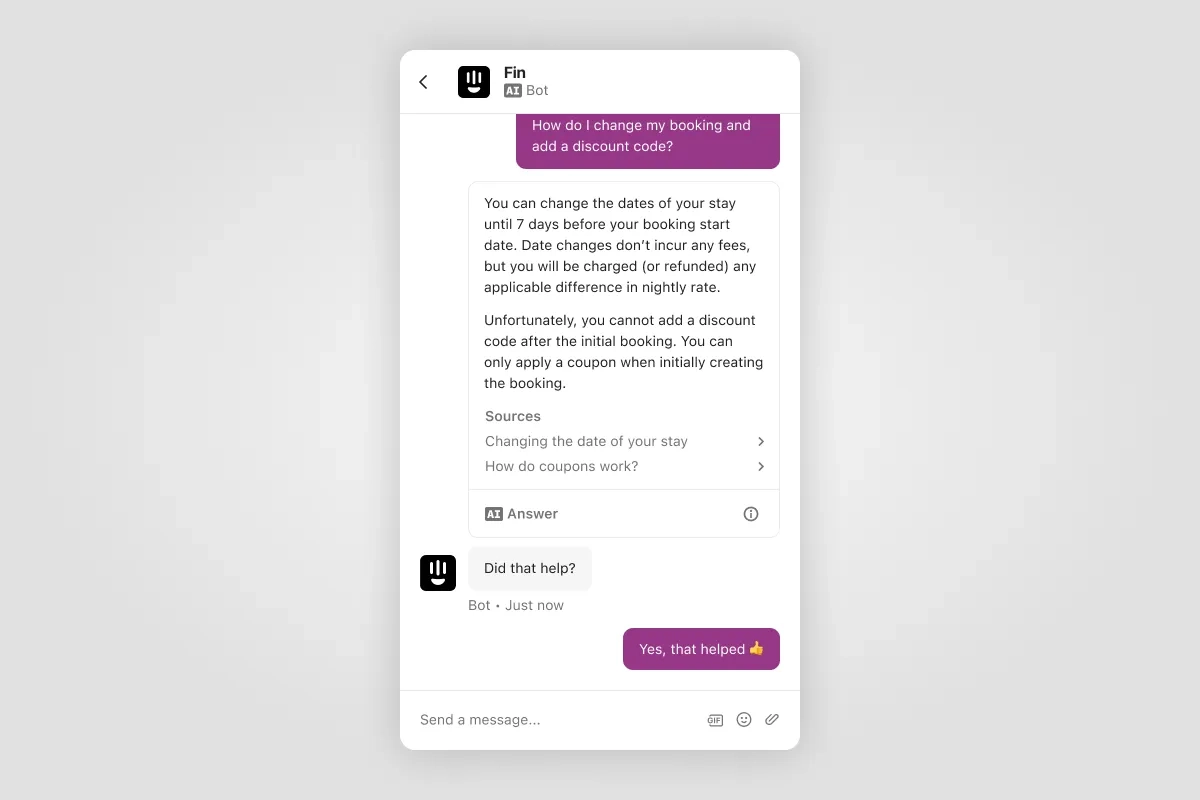
Fin is Intercom's AI agent, built to resolve common questions independently before a human is involved. It answers from your help content and escalates cleanly, making it one of the strongest pre-built resolution agents available.
- Autonomous resolution: Closes common questions without human input.
- Content-trained: Learns from help centers, websites, and files.
- Native handover: Escalates with team notifications.
- 95+ languages: Broad multilingual coverage.
Ada
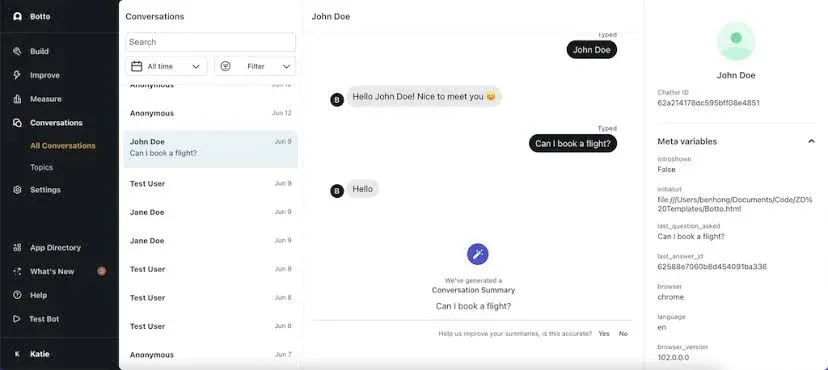
Ada is an AI resolution engine used by companies like Meta, Shopify, and Square to automate customer service at scale. Rather than deflecting questions to FAQ pages, it completes actions such as processing refunds and tracking orders. It trains on your existing help center content and selects the best language model for each query automatically.
- AI Resolution Engine: Completes real tasks, not just answers.
- Multi-model routing: Picks the best AI model per query for accuracy.
- No-code builder: Support managers update flows without engineering help.
- 50+ languages: Cultural adaptation, not just translation.
Kore.ai
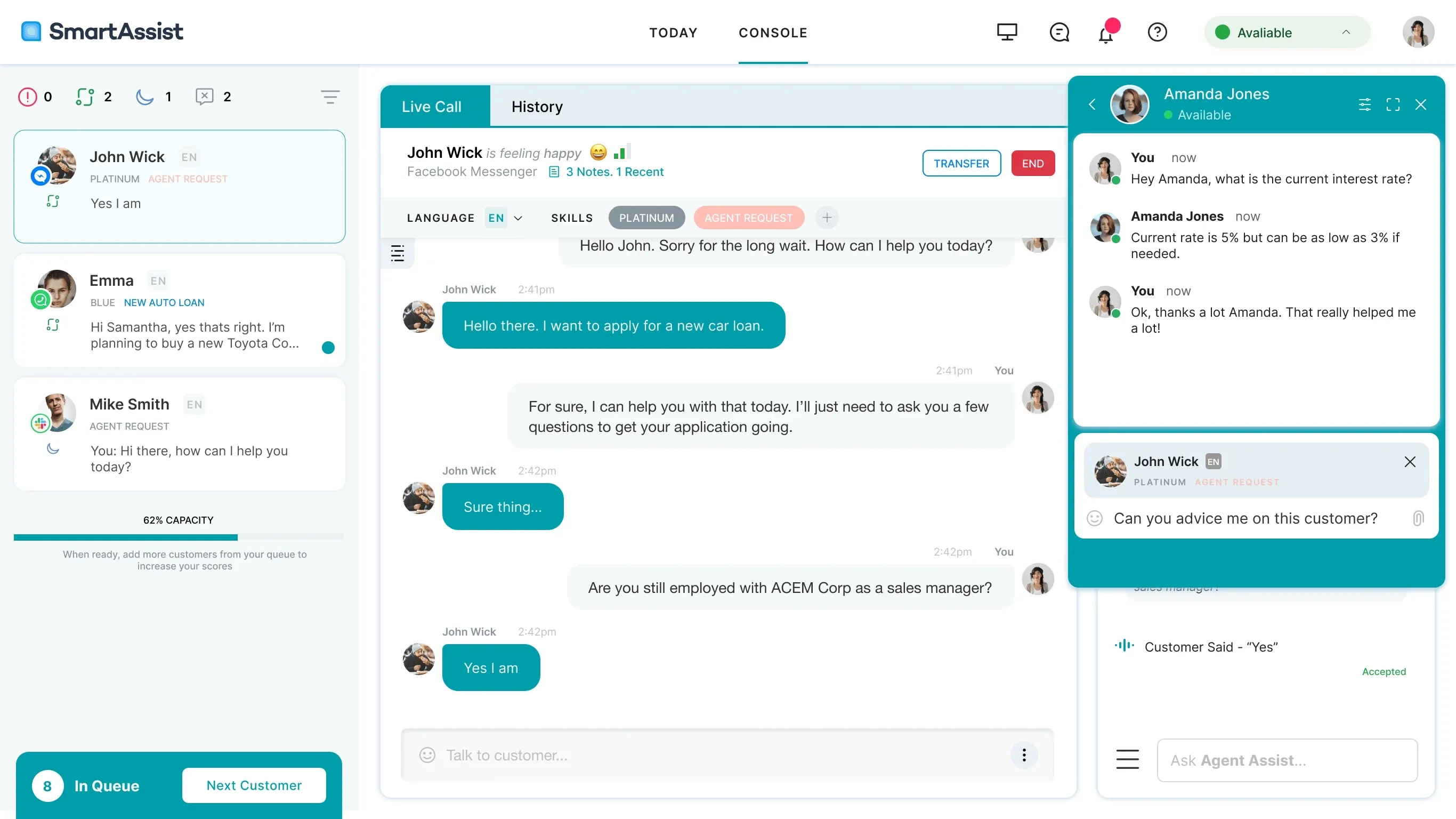
Kore.ai is an enterprise conversational AI platform built for large-scale, complex automation across customer service, IT, and HR. It offers deep customization, strong governance, and orchestration across many systems, which is why global enterprises in regulated industries choose it. Well-tuned deployments reach high containment rates that cut live-agent volume significantly.
- Agent orchestration: Coordinates multiple AI agents across departments.
- Configurable NLP: Handles complex queries with intent-based and generative AI.
- Omnichannel deployment: Web, mobile, voice, messaging, and IVR.
- Enterprise governance: Strong security and compliance for regulated sectors.
Drift
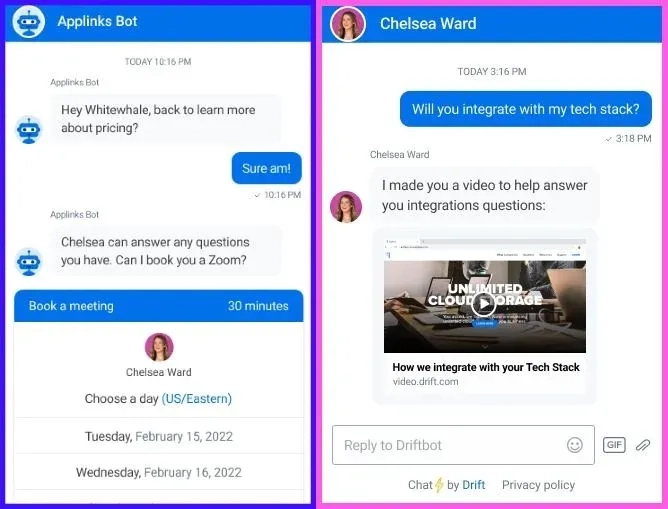
Drift, now part of Salesloft, leads in conversational marketing rather than support. It replaces static contact forms with AI chat that qualifies leads, books meetings, and routes high-intent visitors straight to sales, making it a fit for B2B revenue teams.
- AI lead qualification: Identifies and routes high-value leads automatically.
- Meeting scheduler: Prospects book demos directly from the chat.
- Visitor intelligence: Identifies company, account history, and intent signals.
- CRM-native: Connects directly with Salesforce and HubSpot.
Conclusion
An AI chatbot is now core infrastructure for customer communication, not an optional add-on. It understands customer intent, generates genuine answers, and clears the routine volume that once overwhelmed support teams, provided it is set up well and backed by a human for the cases it cannot resolve.
The right tool depends on the job: a resolution engine for documentation-heavy support, a marketing platform for social campaigns, or an omnichannel system when customers reach you across every channel. If your conversations span WhatsApp, Instagram, and more, SaleSmartly brings the channels, the automation, and the human handover into a single workspace.
Talk to the SaleSmartly team to find the right setup for your business.
FAQ
What is the difference between an AI chatbot and a regular chatbot?
A regular chatbot follows a fixed script and can only provide pre-programmed answers. An AI chatbot understands customer intent and generates its own responses, even for questions it was never scripted for. In short, a rule-based bot matches keywords, while an AI chatbot understands meaning and adapts its replies accordingly.
Can an AI chatbot replace human customer service?
No. AI chatbots handle routine questions effectively, but MIT research shows they can be less accurate for some users and still struggle with complex or sensitive cases. The proven approach is to let the chatbot clear routine volume, then hand off to a human agent with full context. AI manages volume; people handle judgment.
How much does an AI chatbot cost?
It varies by pricing model. Some tools charge per resolution, such as Intercom Fin at $0.99 each, while others charge per agent or per active contact. Flat-rate platforms like SaleSmartly, billed not per agent, keep costs predictable as you scale. Chatbot.com data places a typical AI interaction near $0.50, against $6 to $15 for a human agent.
10 AI Bots for Customer Service in Indonesia Worth Buying
Compare the 10 best AI bots for customer service in Indonesia in 2026, with features, pricing, and who each one suits, so you pick the right fit.
Types of Chatbots: How to Choose the Right Platform for Your Business
A clear guide to the main types of chatbots, from rule-based to generative AI, with features, use cases, and how to choose the right one for your business.
